Description
Form
herbaceous, annual
Height: 15–50 cm
Flower colour
WhiteBluePurple
Flowering
No reliable data in the sources.
Habitat
Leaves
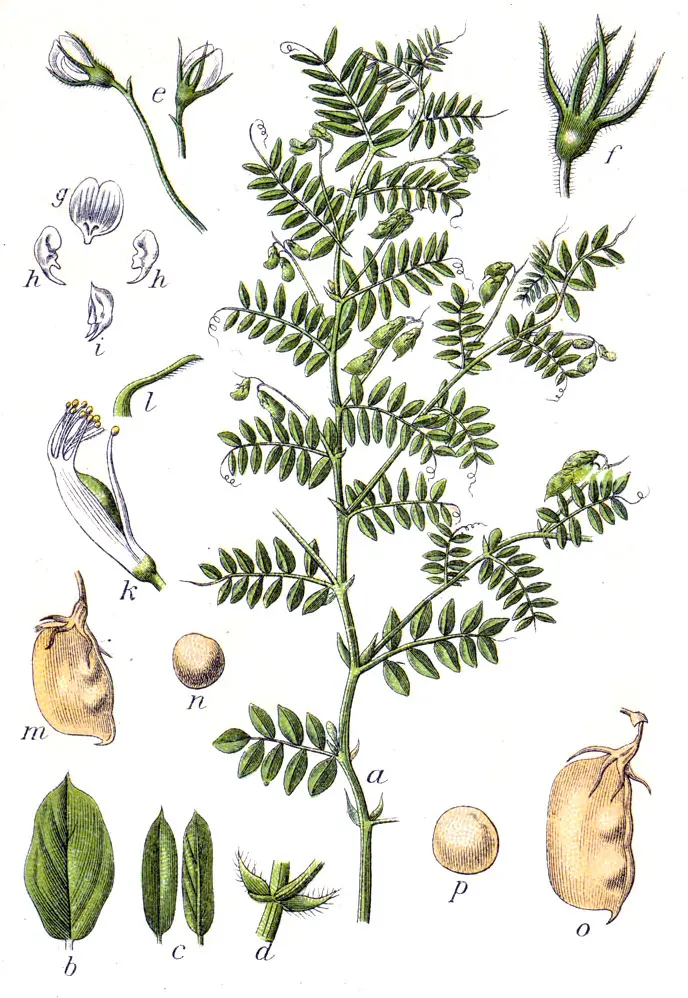
Pinnate leaves with small, narrow leaflets, often ending in a short tendril.
Flowers
Very small, pea-like flowers, white, pale blue or light purple.
Fruit and seeds
A short, flat pod with one or two lens-shaped seeds.
Classification
- KingdomPlantae
- PhylumTracheophyta
- ClassMagnoliopsida
- OrderFabales
- FamilyFabaceae
- GenusVicia
- SpeciesVicia lens
Native range
According to POWO it is native to Iran, Iraq, Afghanistan, Pakistan and the western Himalaya, and to Morocco, Algeria, Spain and France. POWO treats the cultivated lentil as introduced in Türkiye. It was domesticated in the Fertile Crescent and spread from there to Europe and North Africa.
Growing conditions
Light
Full sun.
Water
Little; drought tolerant.
Soil
Free-draining soil.
Temperature
Grows in the cool season.
Fixes nitrogen from the air through bacteria in its roots.
Culture and history
Lens and lentil
The lentil's Latin name is "lens". The optical lens is named after the seed, which bulges outwards on both sides.
Look-alikes
- Chickpea: A sturdier, glandular-hairy plant with toothed leaflets and short, inflated pods. Compare side by side →
Questions
What is the lentil's scientific name?
It was long known as Lens culinaris; POWO and World Flora Online now accept Vicia lens.
Are red and green lentils different plants?
No, they are varieties of one species; red lentils are usually dehulled and split.
Lentil: how do you grow it?
Light: Full sun. Water: Little; drought tolerant. Soil: Free-draining soil. Temperature: Grows in the cool season. Fixes nitrogen from the air through bacteria in its roots.
Sources
- Wikipedia: Lentil
- World Flora Online
- Plants of the World Online (Kew) · native range (WCVP)
- GBIF · classification
- Wikidata
Checked: 2026-11-16. Spotted a mistake? Tell us.