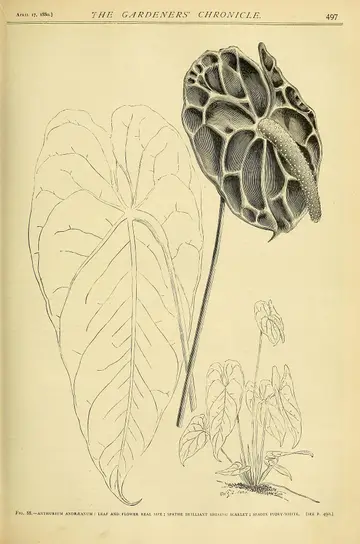
Description
Form
herbaceous, perennial, evergreen
Height: 1–2 m in a pot; up to 4 m in the wild
Flower colour
White
Flowering
No reliable data in the sources.
Leaves
Very large, upright, shield- or heart-shaped, glossy green leaves with prominent veins, held on thick, fleshy stalks.
Flowers
A fragrant spike (spadix) inside a cream-coloured hood-like bract (spathe).
Fruit and seeds
Small red berries.
Classification
- KingdomPlantae
- PhylumTracheophyta
- ClassLiliopsida
- OrderAlismatales
- FamilyAraceae
- GenusAlocasia
- SpeciesAlocasia macrorrhizos
Native range
According to POWO it is native to Borneo, Sulawesi, the Moluccas, the Philippines, New Guinea, the Bismarck and Solomon Islands and Queensland.
Care
Light
Bright, indirect light.
Water
Keep the soil lightly moist without waterlogging.
Soil
Humus-rich, free-draining soil.
Temperature
18–30 °C; not cold tolerant.
Growth slows in winter, so water less. It likes humid air.
Toxicity
All parts contain needle-shaped calcium oxalate crystals; chewing causes severe burning and swelling of the mouth and throat, and the sap irritates the skin. This trait of the arum family makes it dangerous for pets too; no ASPCA entry specific to this species was found.
In an emergency call your local poison centre; for pets, contact a vet straight away. See also: plants and pets.
Look-alikes
- Taro (Colocasia esculenta): Also called "elephant ear", but its leaves point downwards and the stalk joins near the middle of the leaf. Alocasia leaves stand more upright.
Questions
How do I tell Alocasia from Colocasia?
Both are called "elephant ear". Alocasia leaves usually stand upright or point up; Colocasia (taro) leaves hang down and the stalk joins near the middle of the leaf.
Giant taro: how do you care for it?
Light: Bright, indirect light. Water: Keep the soil lightly moist without waterlogging. Soil: Humus-rich, free-draining soil. Temperature: 18–30 °C; not cold tolerant. Growth slows in winter, so water less. It likes humid air.
Giant taro: what is its scientific name?
Alocasia macrorrhizos (L.) G.Don, in the genus Alocasia and the family Araceae.
Sources
- Wikipedia: Alocasia macrorrhizos
- World Flora Online
- Plants of the World Online (Kew) · native range (WCVP)
- GBIF · classification
- Wikidata
Checked: 2026-11-16. Spotted a mistake? Tell us.