Description
Form
herbaceous, perennial
Height: 30–60 cm (flower stalk up to 1 m)
Flower colour
WhitePink
Flowering
No reliable data in the sources.
Leaves
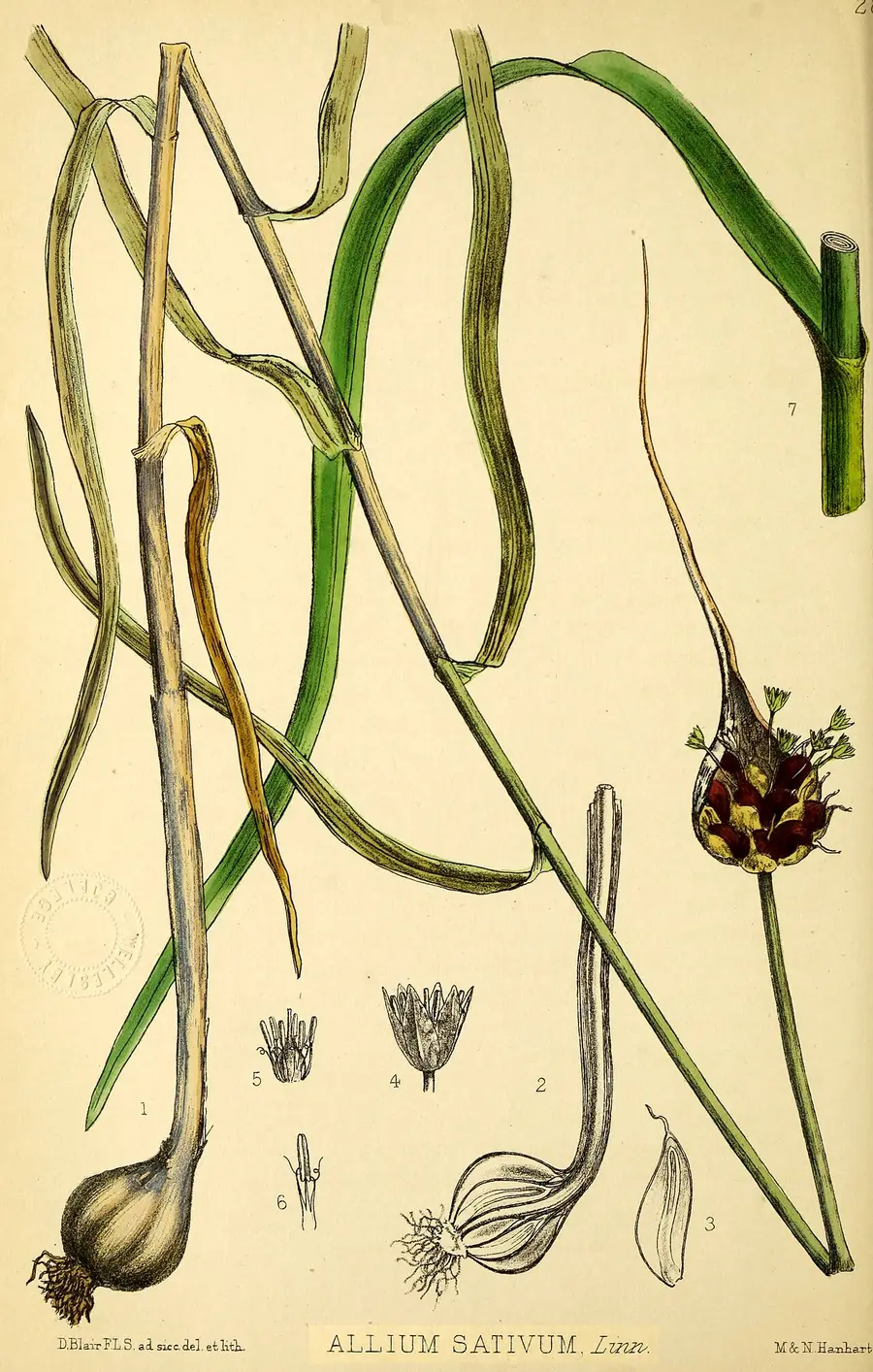
Flat, narrow, strap-shaped leaves, not tubular like an onion's.
Flowers
Some varieties produce a curled stalk (scape) with an umbel of small white-pinkish flowers mixed with tiny bulbils; most flowers set no seed.
Fruit and seeds
Most cultivated varieties set no seed.
Classification
- KingdomPlantae
- PhylumTracheophyta
- ClassLiliopsida
- OrderAsparagales
- FamilyAmaryllidaceae
- GenusAllium
- SpeciesAllium sativum
Native range
According to POWO it is native to Iran, Turkmenistan, Uzbekistan, Tajikistan, Kyrgyzstan and Kazakhstan, and introduced everywhere else, including Türkiye.
Growing conditions
Light
Full sun.
Water
Low to moderate; stop watering near harvest.
Soil
Free-draining, loose soil.
Temperature
Hardy; usually planted in autumn and harvested in summer.
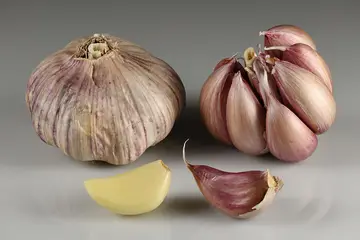
Grown from cloves: each clove makes a new bulb.
Culture and history
Taşköprü garlic
Garlic grown in Taşköprü, Kastamonu, is a registered geographical indication of the Turkish Patent and Trademark Office.
Toxicity
ASPCA lists garlic as toxic to cats, dogs and horses. It contains N-propyl disulfide, which can destroy red blood cells (haemolytic anaemia). Signs include vomiting, blood in the urine, weakness, a fast heart rate and panting. Cooked and dried forms are dangerous too.
In an emergency call your local poison centre; for pets, contact a vet straight away. See also: plants and pets.
Look-alikes
- Onion: Same genus; its leaves are tubular and its bulb does not divide into cloves. Compare side by side →
- Autumn crocus and other poisonous bulbs: Plants gathered as "wild garlic" can be confused with deadly poisonous species such as autumn crocus and lily of the valley. Do not gather wild plants. Compare side by side →
Questions
Is garlic grown from seed?
Most cultivated varieties set no seed; garlic is grown by planting individual cloves.
Is garlic toxic to dogs?
Yes. ASPCA lists garlic as toxic to cats, dogs and horses; it can damage red blood cells.
Garlic: what is its scientific name?
Allium sativum L., in the genus Allium and the family Amaryllidaceae.
Sources
- Wikipedia: Garlic
- World Flora Online
- Plants of the World Online (Kew) · native range (WCVP)
- GBIF · classification
- Wikidata
- ASPCA Animal Poison Control: Garlic
- Türk Patent ve Marka Kurumu: Coğrafi İşaretler
Checked: 2026-11-16. Spotted a mistake? Tell us.