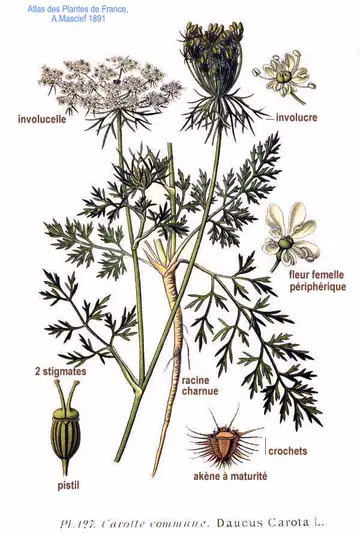
Description
Form
herbaceous, annual
Height: 20–50 cm
Flower colour
WhitePink
Flowering
May–July
Habitat
Leaves
Thread-like, finely divided, bluish-green leaves.
Flowers
Small white or pink flowers in small umbrella-shaped heads.
Fruit and seeds
Elongated, ribbed, fragrant dry fruits; the part used as a spice.
Classification
- KingdomPlantae
- PhylumTracheophyta
- ClassMagnoliopsida
- OrderApiales
- FamilyApiaceae
- GenusCuminum
- SpeciesCuminum cyminum
Native range
According to POWO it is native to Iran, Iraq and Afghanistan. It has been grown for thousands of years from the Mediterranean to India.
Culture and history
An ancient spice
Cumin is known to have been used in ancient Egypt and Mesopotamia; it was also a common spice in ancient Greece and Rome.
Look-alikes
- Coriander: Same family, but its lower leaves are broad and parsley-like and its fruits are round. Compare side by side →
- Poison hemlock (Conium maculatum): Deadly poisonous member of the same family, with white umbrella-shaped flower heads too; it is much taller, its stem is smooth with purple blotches and it smells foul when crushed. Never pick wild plants of the carrot family. Compare side by side →
Questions
Are cumin seeds really seeds?
No. The cumin "seeds" used as a spice are small dry fruits, typical of the carrot family, each containing a seed.
Cumin: when does it flower?
In spring and summer: May–July. Months are for temperate northern-hemisphere climates and shift with altitude and weather.
Cumin: what is its scientific name?
Cuminum cyminum L., in the genus Cuminum and the family Apiaceae.
Sources
- Wikipedia: Cumin
- World Flora Online
- Plants of the World Online (Kew) · native range (WCVP)
- GBIF · classification
- Wikidata
Checked: 2026-11-17. Spotted a mistake? Tell us.