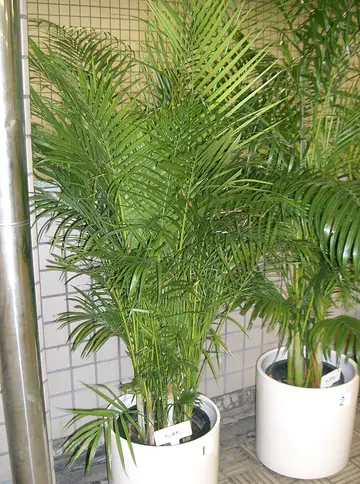
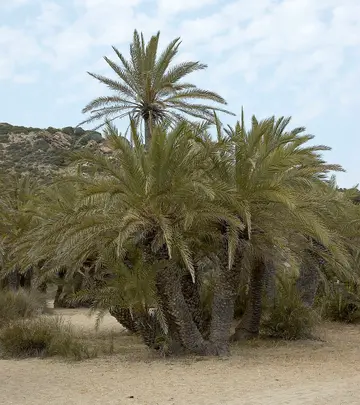
Description
Form
palm, perennial, evergreen
Height: 10–20 m
Flower colour
Yellow
Flowering
March–May
Habitat
Leaves
Feather-like leaves 4–6 m long with 80–100 leaflets on each side of the midrib; the leaflets near the base have turned into stiff spines. A tree usually has 75–125 living leaves.
Flowers
Small cream-yellow flowers in branched clusters hanging among the leaves; male and female trees are separate.
Fruit and seeds
Oval, one-seeded fruits about 2 cm long, turning from yellow to orange; only on female trees.
Classification
- KingdomPlantae
- PhylumTracheophyta
- ClassLiliopsida
- OrderArecales
- FamilyArecaceae
- GenusPhoenix
- SpeciesPhoenix canariensis
Native range
According to POWO it is native only to the Canary Islands. It is planted as an ornamental all over the world in Mediterranean and mild, humid climates.
IUCN Red List status: Least concern (LC).
Growing conditions
Light
Full sun.
Water
Moderate; drought tolerant once established.
Soil
Free-draining soil.
Temperature
Tolerates brief cold down to about −10 °C; young plants suffer more from frost.
Grows slowly and is propagated only from seed. The spines at the leaf bases can cause injuries.
Culture and history
Symbol of the Canary Islands
Together with the canary, the Canary Island date palm is the natural symbol of the Canary Islands.
Toxicity
ASPCA lists the Canary Island date palm as non-toxic to cats, dogs and horses. The stiff spines at the leaf bases can cause injuries.
In an emergency call your local poison centre; for pets, contact a vet straight away. See also: plants and pets.
Look-alikes
- Date palm: The true date palm; its trunk is slimmer and taller, its leaves greyish-green, and it produces suckers at the base. Compare side by side →
- Cretan date palm: The only palm native to Türkiye; it forms multi-stemmed clumps and stays shorter. Compare side by side →
Questions
Can you eat Canary Island date palm fruit?
According to Wikipedia the pulp is edible but not a good date; the tree is planted as an ornamental, not for its fruit.
Is the Canary Island date palm toxic to pets?
ASPCA lists it as non-toxic to cats, dogs and horses.
Canary Island date palm: when does it flower?
In spring: March–May. Months are for temperate northern-hemisphere climates and shift with altitude and weather.
Canary Island date palm: how do you grow it?
Light: Full sun. Water: Moderate; drought tolerant once established. Soil: Free-draining soil. Temperature: Tolerates brief cold down to about −10 °C; young plants suffer more from frost. The spines at the leaf bases can cause injuries.
Canary Island date palm: how do you propagate it?
Grows slowly and is propagated only from seed.
Canary Island date palm: what is its scientific name?
Phoenix canariensis H.Wildpret, in the genus Phoenix and the family Arecaceae.
Sources
- Wikipedia: Phoenix canariensis
- ASPCA: Canary Island Date Palm
- World Flora Online
- Plants of the World Online (Kew) · native range (WCVP)
- GBIF · classification
- Wikidata
Checked: 2026-11-17. Spotted a mistake? Tell us.