Telling them apart
Canary Island date palm vs Cretan date palm
Canary Island date palm (Phoenix canariensis) and Cretan date palm (Phoenix theophrasti) look similar enough to be confused. Both belong to the same family, Arecaceae (palm family).
Image wanted. A licensed image will be added when found.
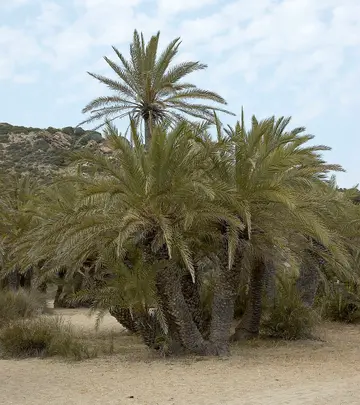
How to tell them apart
- Cretan date palm: The only palm native to Türkiye; it forms multi-stemmed clumps and stays shorter.
- Canary Island date palm: The palm most often planted in coastal towns; a single, very thick trunk and a much wider, green crown.
Side by side
| Canary Island date palm | Cretan date palm | |
|---|---|---|
| Scientific name | Phoenix canariensis | Phoenix theophrasti |
| Family | Arecaceae (palm family) | Arecaceae (palm family) |
| Form | palm, perennial, evergreen | palm, perennial, evergreen |
| Height | 10–20 m | 10–17 m |
| Flower colour | Yellow | White |
| Origin | Canary Islands | Southwestern Türkiye, Crete and the East Aegean |
| Toxicity | Cats: non-toxic · Dogs: non-toxic | — |
| Flowering | — | |
| Leaves | Feather-like leaves 4–6 m long with 80–100 leaflets on each side of the midrib; the leaflets near the base have turned into stiff spines. A tree usually has 75–125 living leaves. | Feather-shaped leaves 2–3 m long, stiff and bluish green; the lowest leaflets are modified into hard spines. It usually forms clumps of several trunks. |
| Flowers | Small cream-yellow flowers in branched clusters hanging among the leaves; male and female trees are separate. | Male and female flowers on separate plants; small cream flowers in hanging clusters among the leaves. |
| Fruit and seeds | Oval, one-seeded fruits about 2 cm long, turning from yellow to orange; only on female trees. | Small, brown-black, fibrous and astringent dates; not grown for eating like the true date palm. |
All pairs: look-alike plants · Full pages: Canary Island date palm, Cretan date palm