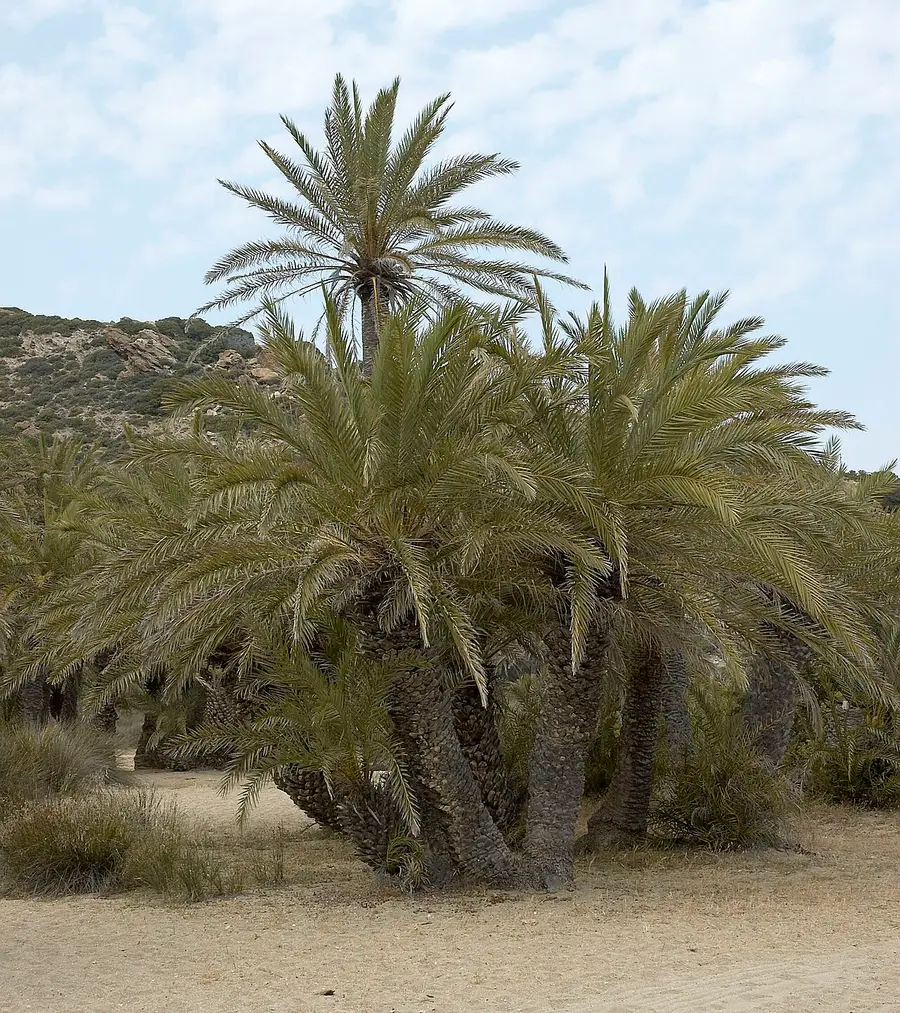
Description
Form
palm, perennial, evergreen
Height: 10–17 m
Flower colour
White
Flowering
No reliable data in the sources.
Leaves
Feather-shaped leaves 2–3 m long, stiff and bluish green; the lowest leaflets are modified into hard spines. It usually forms clumps of several trunks.
Flowers
Male and female flowers on separate plants; small cream flowers in hanging clusters among the leaves.
Fruit and seeds
Small, brown-black, fibrous and astringent dates; not grown for eating like the true date palm.
Classification
- KingdomPlantae
- PhylumTracheophyta
- ClassLiliopsida
- OrderArecales
- FamilyArecaceae
- GenusPhoenix
- SpeciesPhoenix theophrasti
Native range
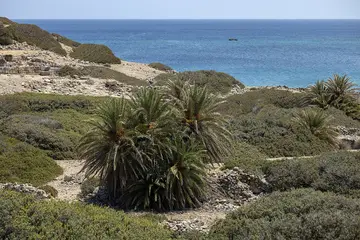
According to POWO its native range is Türkiye, Crete and the East Aegean Islands. The best-known grove on Crete is at Vai beach. In Türkiye it forms small groups in valleys near the coast with a high water table.
IUCN Red List status: Near threatened (NT).
Culture and history
The name
Swiss botanist Werner Greuter described the species in 1967 and named it after Theophrastus, the ancient "father of botany", who mentioned a palm on Crete.
Look-alikes
- Canary Island date palm (Phoenix canariensis): The palm most often planted in coastal towns; a single, very thick trunk and a much wider, green crown. Compare side by side →
- Date palm (Phoenix dactylifera): Taller and single-trunked, with large sweet dates. Compare side by side →
Questions
Is the Cretan date palm native to Türkiye?
Yes. It is the only palm native to Türkiye, found in a few coastal valleys of the southwest, especially on the Datça Peninsula.
Cretan date palm: what is its scientific name?
Phoenix theophrasti Greuter, in the genus Phoenix and the family Arecaceae.
Sources
- Wikipedia: Phoenix theophrasti
- World Flora Online
- Plants of the World Online (Kew) · native range (WCVP)
- GBIF · classification
- Wikidata
Checked: 2026-11-16. Spotted a mistake? Tell us.