Description
Form
tree, perennial, evergreen
Height: 10–20 m
Flower colour
GreenYellow
Flowering
February–April
Habitat
Leaves
Large, elliptic, leathery, dark green leaves with smooth edges.
Flowers
Small, yellowish-green flowers in clusters. Each flower opens over two days, first as female, then as male; cultivars are divided into A and B types by these opening times.
Fruit and seeds
A pear-shaped berry with green or purple-black skin, oily flesh and a single large stone.
Classification
- KingdomPlantae
- PhylumTracheophyta
- ClassMagnoliopsida
- OrderLaurales
- FamilyLauraceae
- GenusPersea
- SpeciesPersea americana
Native range
According to POWO it is native to central and southern Mexico and Central America (Guatemala, Belize, Honduras, Nicaragua, Costa Rica). Today it is grown in tropical and subtropical regions worldwide.
IUCN Red List status: Least concern (LC).
Growing conditions
Light
Full sun.
Water
Regular, but it cannot stand waterlogging at all.
Soil
Deep, very free-draining soil.
Temperature
Not frost hardy; young trees are damaged even by light frost.
Planting A-type and B-type cultivars together is recommended for fruit set.
Culture and history
The name
The word avocado comes, through Spanish, from the Aztec (Nahuatl) word ahuacatl.
Toxicity
ASPCA lists the avocado as toxic to horses; the toxin is persin, found in the leaves, skin and stone. In horses the signs are breathing difficulty, heart failure and fluid build-up (oedema). Persin is also known to be toxic to birds and some small animals.
In an emergency call your local poison centre; for pets, contact a vet straight away. See also: plants and pets.
Look-alikes
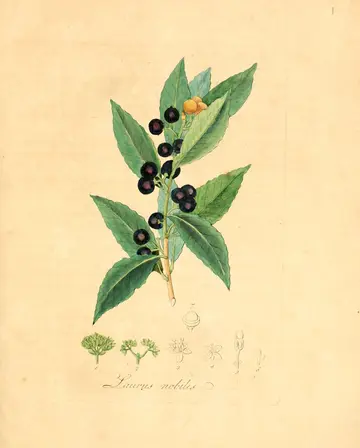
- Bay laurel: Same family (Lauraceae); its leaves are also leathery and aromatic, but much smaller. Compare side by side →
Questions
Can you grow an avocado from a stone?
Yes, the stone germinates easily and makes a handsome pot plant. But a tree grown from a stone does not come true to its parent and may take many years to fruit; orchards use grafted trees.
Is avocado toxic to pets?
ASPCA lists avocado as toxic to horses; the persin in its leaves, skin and stone is also toxic to birds.
Avocado: when does it flower?
In winter and spring: February–April. Months are for temperate northern-hemisphere climates and shift with altitude and weather.
Avocado: what is its scientific name?
Persea americana Mill., in the genus Persea and the family Lauraceae.
Sources
- Wikipedia: Avocado
- ASPCA Animal Poison Control: Avocado (Persea americana)
- World Flora Online
- Plants of the World Online (Kew) · native range (WCVP)
- GBIF · classification
- Wikidata
Checked: 2026-11-17. Spotted a mistake? Tell us.