Description
Form
tree, perennial, deciduous
Height: 2–4.5 m in cultivation; up to 15 m in the wild
Flower colour
WhitePink
Flowering
April–May
Leaves
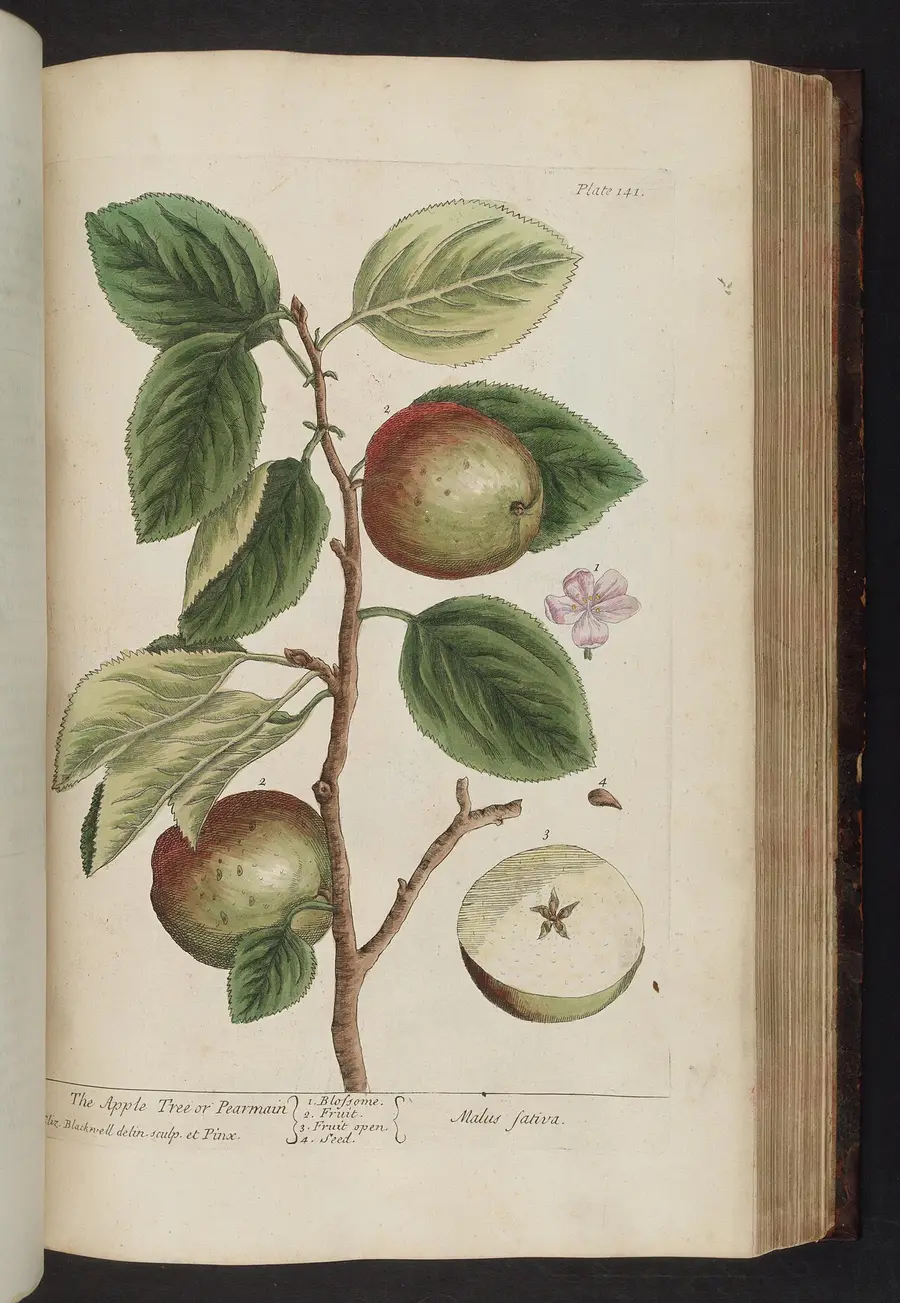
Alternate, oval leaves with toothed edges; almost hairless above, densely and finely hairy underneath.
Flowers
White or pinkish five-petalled flowers in clusters on short shoots, opening with the leaves. Apples are self-incompatible and need another variety flowering at the same time nearby to set fruit. Open blossoms are damaged by even a brief frost of −2 °C.
Fruit and seeds
Botanically a "false fruit": the edible flesh develops from the flower base, and the core with the pips is the true fruit.
Classification
- KingdomPlantae
- PhylumTracheophyta
- ClassMagnoliopsida
- OrderRosales
- FamilyRosaceae
- GenusMalus
- SpeciesMalus domestica
Native range
According to POWO it is native to Kazakhstan, Kyrgyzstan, Tajikistan, Uzbekistan, Afghanistan, Pakistan and Xinjiang and Qinghai in China. The main ancestor of the cultivated apple is Malus sieversii of the wild apple forests of the Tian Shan. It is now grown throughout the temperate world.
Growing conditions
Light
Full sun.
Water
Regular; drought while fruiting makes the fruit smaller.
Soil
Deep, well-drained, fertile soil.
Temperature
Needs enough winter chill to flower; late spring frosts damage the blossom.
Varieties do not come true from seed, so every variety is propagated by grafting.
Culture and history
Apples don't come true from seed
A tree grown from an apple pip does not resemble its parent. That is why every named variety, from the Turkish Amasya apple to Granny Smith, has been grafted for generations: all trees of one variety are copies of a single original tree.
Toxicity
ASPCA lists apple (entry under Malus sylvestris) as toxic to cats, dogs and horses: the stems, leaves and seeds contain cyanogenic glycosides. The flesh of the fruit is not considered dangerous.
In an emergency call your local poison centre; for pets, contact a vet straight away. See also: plants and pets.
Look-alikes
- Pear: Its blossom has dark red-purple anthers, its leaves are glossy and hairless, and its fruit has a gritty texture. Compare side by side →
- Quince: Its large, pale pink flowers open singly and its golden fruit is downy and very fragrant. Compare side by side →
Questions
Where do apples come from?
From the wild apple forests of the Tian Shan in Central Asia, especially in Kazakhstan and Kyrgyzstan; the apple spread west along the Silk Road.
Apple: when does it flower?
In spring: April–May. Months are for temperate northern-hemisphere climates and shift with altitude and weather.
Apple: how do you grow it?
Light: Full sun. Water: Regular; drought while fruiting makes the fruit smaller. Soil: Deep, well-drained, fertile soil. Temperature: Needs enough winter chill to flower; late spring frosts damage the blossom.
Apple: how do you propagate it?
Varieties do not come true from seed, so every variety is propagated by grafting.
Apple: is it toxic to cats and dogs?
Toxic to cats and dogs. Seeds, leaves, stems: cyanogenic glycosides.
Apple: what is its scientific name?
Malus domestica (Suckow) Borkh., in the genus Malus and the family Rosaceae.
Sources
- Wikipedia: Apple
- World Flora Online
- Plants of the World Online (Kew) · native range (WCVP)
- GBIF · classification
- Wikidata
- Wikipedia
- ASPCA Animal Poison Control: Apple (Malus sylvestris)
Checked: 2026-11-16. Spotted a mistake? Tell us.