Description
Form
tree, perennial, deciduous
Height: 5–10 m
Flower colour
WhitePink
Flowering
March–April
Leaves
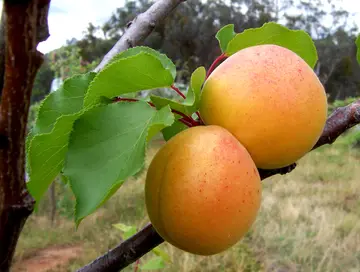
Roundish, pointed leaves with finely toothed edges and reddish stalks.
Flowers
White or pale pink flowers on short stalks along the branches, before the leaves.
Fruit and seeds
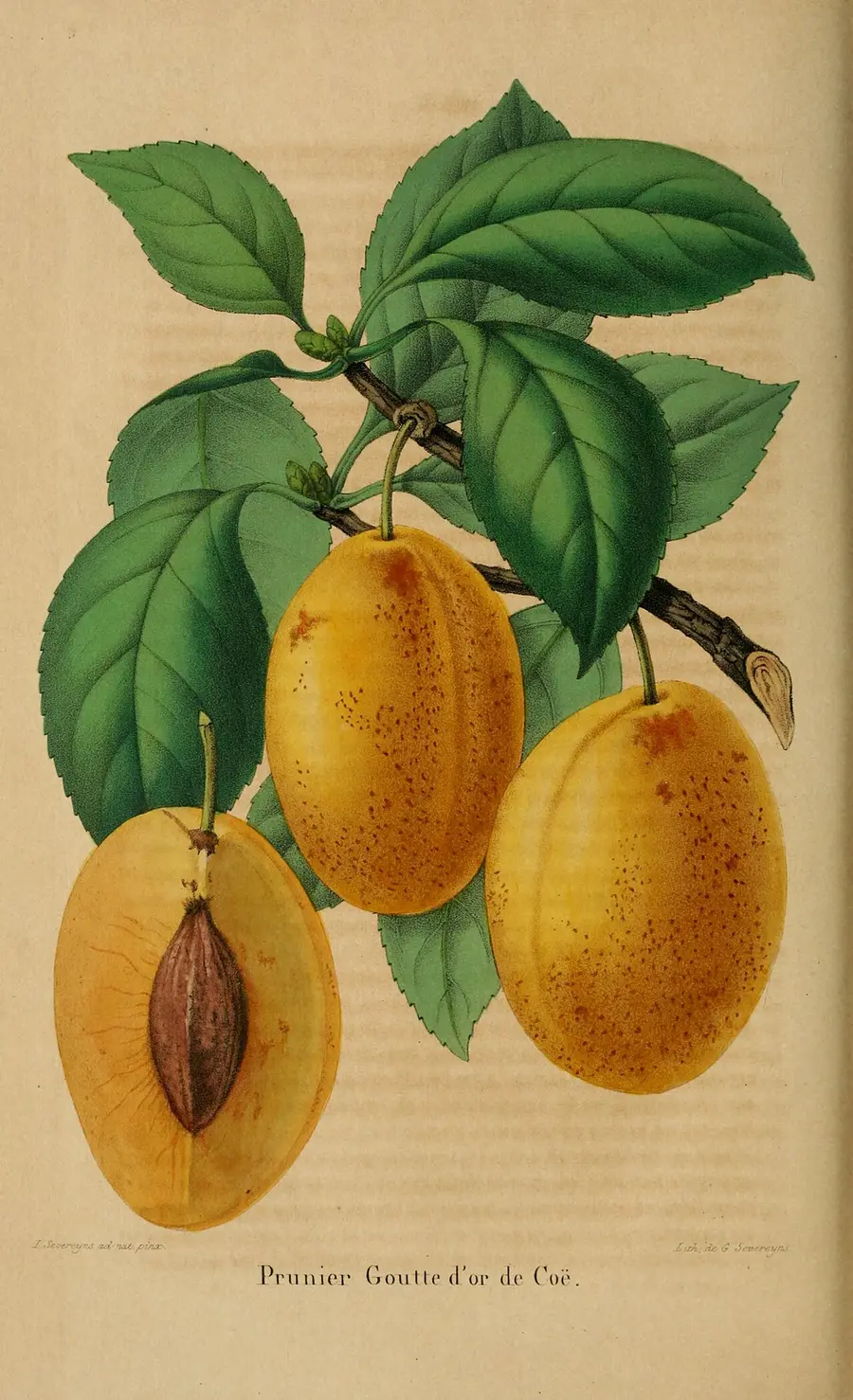
An orange-yellow stone fruit with a velvety skin and a single stone.
Classification
- KingdomPlantae
- PhylumTracheophyta
- ClassMagnoliopsida
- OrderRosales
- FamilyRosaceae
- GenusPrunus
- SpeciesPrunus armeniaca
Native range
According to POWO it is native to Kazakhstan, Kyrgyzstan, Uzbekistan, Xinjiang, Qinghai and north-central China, Inner Mongolia and Manchuria. It spread west along the Silk Road.
IUCN Red List status: Data deficient (DD).
Growing conditions
Light
Full sun.
Water
Low to moderate; drought tolerant.
Soil
Well-drained, limy soil.
Temperature
Survives cold winters, but because it flowers early, spring frosts are the main danger.
Culture and history
The name
Its scientific name "armeniaca" comes from the Romans knowing the apricot via Armenia; Europeans long believed it came from there.
Toxicity
ASPCA lists the genus Prunus as toxic to cats, dogs and horses: the stems, leaves and stones contain cyanogenic glycosides, and wilting leaves are the most dangerous. Signs include brick-red mucous membranes, dilated pupils, difficulty breathing, panting and shock. The ripe flesh of the fruit is not considered dangerous; the stones should not be swallowed. Bitter apricot kernels contain amygdalin; eating many can cause cyanide poisoning in people.
In an emergency call your local poison centre; for pets, contact a vet straight away. See also: plants and pets.
Look-alikes
- Almond (Prunus dulcis): Also flowers in late winter before the leaves; its leaves are long and narrow and its fruit has a dry, leathery husk.
- Sweet cherry: Its white flowers hang on long stalks and open with the leaves. Compare side by side →
- European plum (Prunus domestica): Same genus, also with a single-stoned fruit, but plums are smooth-skinned, often with a whitish bloom, and purple, blue, yellow, green or red depending on the variety. Its leaves are elliptic and its flowers open with the leaves. Apricots are orange-yellow and velvety, with roundish leaves on reddish stalks. Compare side by side →
Questions
Which country produces the most apricots?
Türkiye, and the province of Malatya is the world centre of dried apricot production.
Apricot: when does it flower?
In spring: March–April. Months are for temperate northern-hemisphere climates and shift with altitude and weather.
Apricot: how do you grow it?
Light: Full sun. Water: Low to moderate; drought tolerant. Soil: Well-drained, limy soil. Temperature: Survives cold winters, but because it flowers early, spring frosts are the main danger.
Apricot: is it toxic to cats and dogs?
Toxic to cats and dogs and people. Stones, leaves, stems: cyanogenic glycosides.
Apricot: what is its scientific name?
Prunus armeniaca L., in the genus Prunus and the family Rosaceae.
Sources
- Wikipedia: Apricot
- World Flora Online
- Plants of the World Online (Kew) · native range (WCVP)
- GBIF · classification
- Wikidata
- Wikipedia
- ASPCA Animal Poison Control: Apricot (Prunus armeniaca)
Checked: 2026-11-16. Spotted a mistake? Tell us.