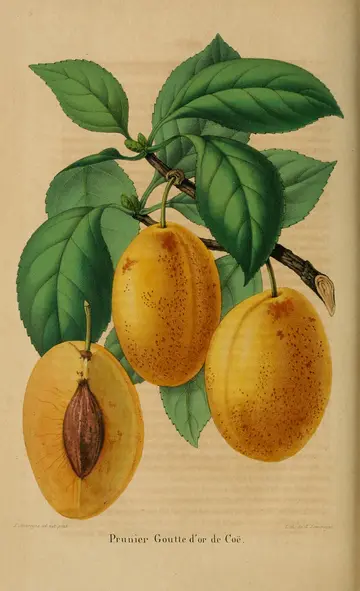
Description
Form
tree, perennial, deciduous
Height: 5–10 m
Flower colour
White
Flowering
March–April
Habitat
Leaves
Alternate, elliptic leaves with blunt-toothed edges, slightly hairy underneath.
Flowers
White flowers with five petals, opening in twos and threes with or just before the leaves.
Fruit and seeds
A juicy, fleshy drupe with a single stone, often covered with a whitish bloom; purple, blue, yellow, green or red depending on the cultivar.
Classification
- KingdomPlantae
- PhylumTracheophyta
- ClassMagnoliopsida
- OrderRosales
- FamilyRosaceae
- GenusPrunus
- SpeciesPrunus domestica
Native range
According to POWO its native range is the Caucasus and Iran. No wild population is known; it is thought to have arisen around the Caucasus from a cross between the cherry plum (Prunus cerasifera) and the blackthorn (Prunus spinosa).
IUCN Red List status: Data deficient (DD).
Growing conditions
Light
Full sun.
Water
Regular watering.
Soil
Deep, fertile, free-draining soil.
Temperature
Cold hardy.
Some cultivars need another plum cultivar nearby to set fruit.
Toxicity
ASPCA lists the plum (Prunus domestica) as toxic to cats, dogs and horses: the stems, leaves and stones contain cyanogenic glycosides, and wilting leaves are especially dangerous. Signs are brick-red mucous membranes, dilated pupils, difficulty breathing and shock. The flesh of the fruit is not considered dangerous; the stones should not be swallowed.
In an emergency call your local poison centre; for pets, contact a vet straight away. See also: plants and pets.
Look-alikes
- Cherry plum (Prunus cerasifera): Flowers earlier and has thin, thornless branches; its fruits are small, round and long-stalked.
- Blackthorn (Prunus spinosa): A dense, thorny shrub covered in snow-white flowers before the leaves in early March; its fruits (sloes) are small, blue-black and very sour.
Questions
Is the cherry plum the same species as the European plum?
Usually not. The early green plums known in Türkiye as "can eriği" are mostly Prunus cerasifera cultivars; large plums such as prune plums are Prunus domestica.
Are plum stones toxic to dogs?
Yes. ASPCA lists the stems, leaves and stones as toxic to cats, dogs and horses because of cyanogenic glycosides.
European plum: when does it flower?
In spring: March–April. Months are for temperate northern-hemisphere climates and shift with altitude and weather.
European plum: how do you grow it?
Light: Full sun. Water: Regular watering. Soil: Deep, fertile, free-draining soil. Temperature: Cold hardy. Some cultivars need another plum cultivar nearby to set fruit.
European plum: what is its scientific name?
Prunus domestica L., in the genus Prunus and the family Rosaceae.
Sources
- Wikipedia: Prunus domestica
- ASPCA Animal Poison Control: Plum (Prunus domestica)
- World Flora Online
- Plants of the World Online (Kew) · native range (WCVP)
- GBIF · classification
- Wikidata
Checked: 2026-11-17. Spotted a mistake? Tell us.