Description
Form
succulent, perennial, evergreen
Height: Strands trail 60–90 cm
Flower colour
White
Flowering
No reliable data in the sources.
Habitat
Leaves
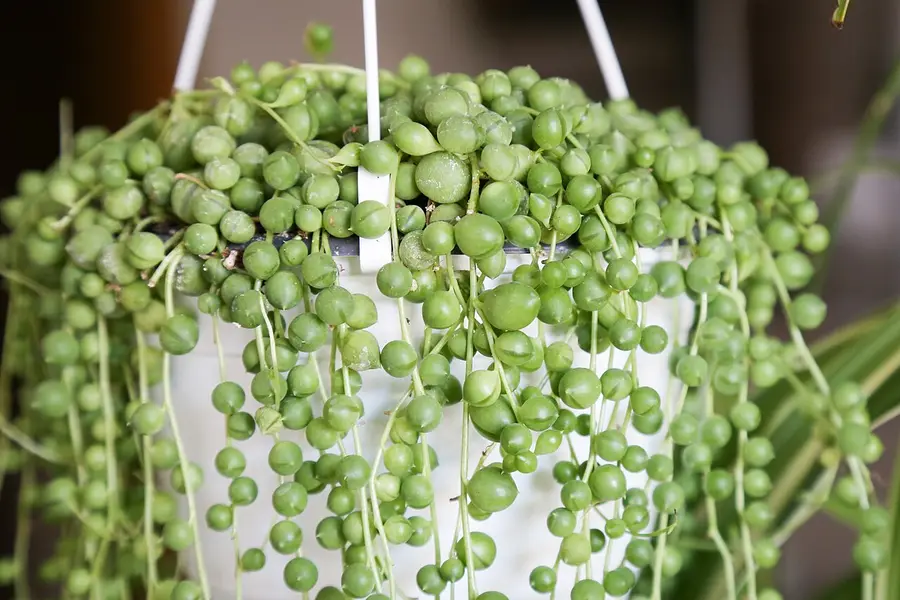
Spherical leaves 6–9 mm across, each with a thin translucent "window" line that lets light inside.
Flowers
Small white pompom flowers that smell of cinnamon.
Classification
- KingdomPlantae
- PhylumTracheophyta
- ClassMagnoliopsida
- OrderAsterales
- FamilyAsteraceae
- GenusCurio
- SpeciesCurio rowleyanus
Native range
According to POWO its native range is the Cape region of South Africa, where it creeps over the ground in the shade of rocks and shrubs in dry areas.
Care
Light
Bright, indirect light; morning sun is fine.
Water
Sparingly; water when the pearls start to wrinkle slightly.
Soil
Cactus mix or a very gritty blend with sand and perlite.
Temperature
10–27 °C.
Strands laid on the soil surface root easily.
Culture and history
A new name
Long known as Senecio rowleyanus, it was moved to the genus Curio after DNA studies.
Look-alikes
- Burro's tail: Another trailing succulent, with plump, elongated leaves packed along thick stems. Compare side by side →
Questions
How often should I water string of pearls?
Only when the pearls begin to wrinkle slightly; wet soil quickly rots the thin stems.
String of pearls: how do you propagate it?
Strands laid on the soil surface root easily.
String of pearls: what is its scientific name?
Curio rowleyanus (H.Jacobsen) P.V.Heath, in the genus Curio and the family Asteraceae.
Sources
- Wikipedia: Curio rowleyanus
- World Flora Online
- Plants of the World Online (Kew) · native range (WCVP)
- GBIF · classification
- Wikidata
Checked: 2026-11-16. Spotted a mistake? Tell us.