Description
Form
herbaceous, perennial
Height: 10–30 cm
Flower colour
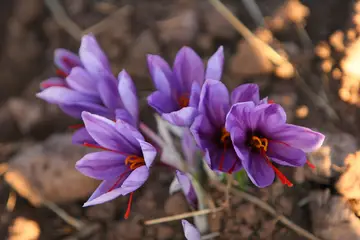
Purple
Flowering
October–November
Leaves
Narrow, grass-like leaves appearing with or just after the flowers.
Flowers
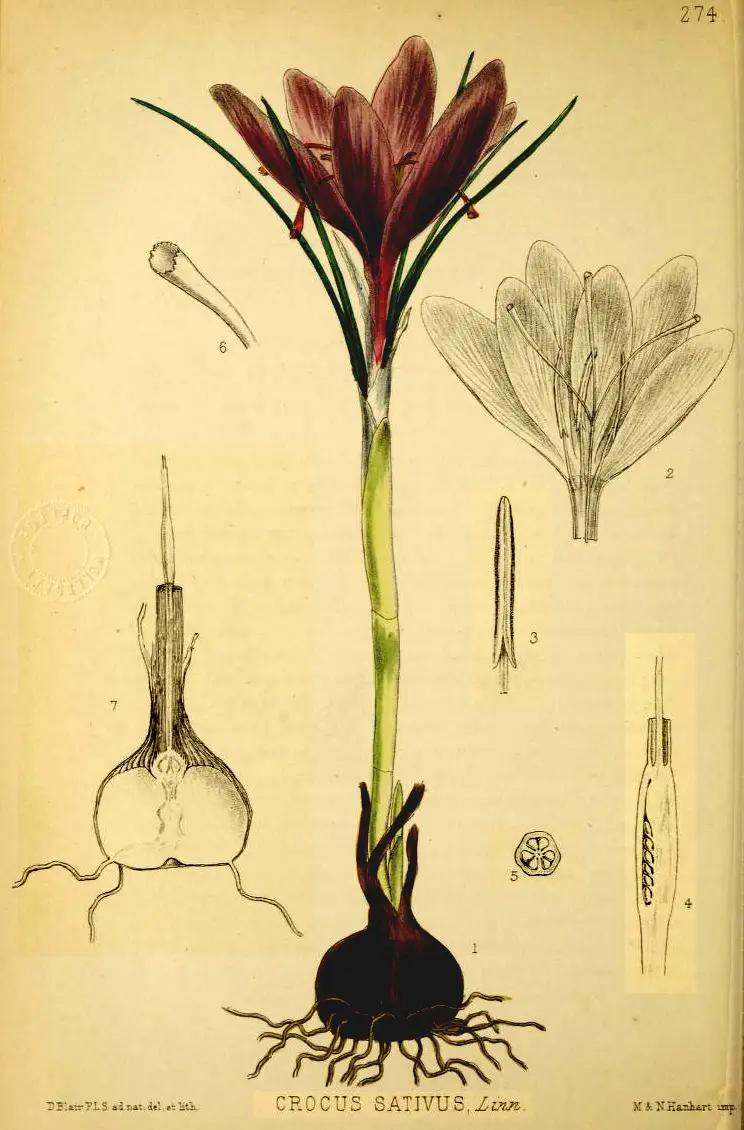
Lilac-purple flowers with six tepals in autumn. Each has three anthers and a single style that divides into three long, deep red stigmas; the spice is these stigmas.
Fruit and seeds
Sterile and sets no seed. The corm makes new daughter corms underground each year.
Classification
- KingdomPlantae
- PhylumTracheophyta
- ClassLiliopsida
- OrderAsparagales
- FamilyIridaceae
- GenusCrocus
- SpeciesCrocus sativus
Native range
The saffron crocus is not known in the wild. POWO treats it as native only to Greece and introduced elsewhere, including Türkiye. Genetic studies show it arose from Crocus cartwrightianus of Greece. It has been grown for more than 3,500 years.
Growing conditions
Light
Full sun.
Water
Little; corms must stay dry while dormant in summer.
Soil
Free-draining, limy soil; corms rot in wet ground.
Temperature
Likes hot, dry summers and cold winters.
Plant the corms in late summer.
Culture and history
Safranbolu
The town of Safranbolu in northern Türkiye takes its name from saffron, which is still grown around it.
The saffron gatherers
Bronze Age frescoes excavated at Akrotiri on Santorini show young women gathering saffron flowers, one of many signs of how long saffron has been valued.
Toxicity
The saffron crocus can be confused with the highly poisonous autumn crocus (Colchicum). True crocuses have 3 stamens and a single style; autumn crocuses have 6 stamens and 3 separate styles.
In an emergency call your local poison centre; for pets, contact a vet straight away. See also: plants and pets.
Look-alikes
- Autumn crocus (Colchicum autumnale): Highly poisonous and also flowers in autumn. It has 6 stamens and 3 styles; the saffron crocus has 3 stamens and one style with three red stigmas. Compare side by side →
Questions
How do you tell saffron crocus from the poisonous autumn crocus?
Count the stamens: saffron crocus has 3 and long red stigmas, the poisonous autumn crocus (Colchicum) has 6 and three separate styles.
Saffron crocus: when does it flower?
In autumn: October–November. Months are for temperate northern-hemisphere climates and shift with altitude and weather.
Saffron crocus: how do you grow it?
Light: Full sun. Water: Little; corms must stay dry while dormant in summer. Soil: Free-draining, limy soil; corms rot in wet ground. Temperature: Likes hot, dry summers and cold winters. Plant the corms in late summer.
Saffron crocus: what is its scientific name?
Crocus sativus L., in the genus Crocus and the family Iridaceae.
Sources
- Wikipedia: Saffron
- World Flora Online
- Plants of the World Online (Kew) · native range (WCVP)
- GBIF · classification
- Wikidata
- Wikipedia
- Wikipedia: Safranbolu
- Wikipedia: Akrotiri (prehistoric city)
Checked: 2026-11-16. Spotted a mistake? Tell us.