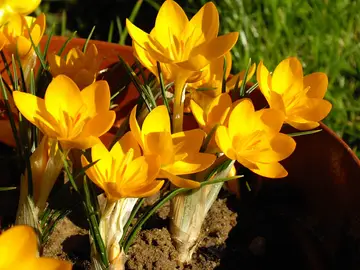
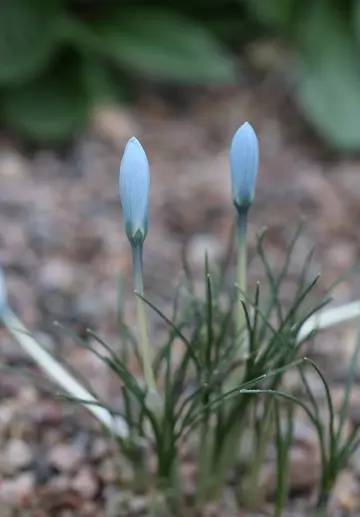
Description
Form
herbaceous (rhizomatous), perennial
Height: 60–120 cm
Flower colour
PurpleBlueWhiteYellow
Flowering
April–June
Habitat
Leaves
Broad, sword-shaped, bluish-green leaves arranged in a fan of two ranks.
Flowers
Of the six parts of the flower, three outer ones (falls) hang down and carry a "beard" of yellowish hairs, and three inner ones (standards) stand upright. The natural form is violet-blue; cultivars come in almost every colour.
Fruit and seeds
A three-angled capsule; many garden plants set no seed and spread by their rhizomes.
Classification
- KingdomPlantae
- PhylumTracheophyta
- ClassLiliopsida
- OrderAsparagales
- FamilyIridaceae
- GenusIris
- SpeciesIris × germanica
Native range
It is a hybrid that arose around the Mediterranean in very ancient times and is not regarded as wild. POWO treats only populations in the western Balkans as native; it has spread as a garden plant across the Mediterranean, including Türkiye, and the world, naturalising in places.
Growing conditions
Light
Full sun.
Water
Drought tolerant; dislikes too much water.
Soil
Free-draining, limy or neutral soil.
Temperature
Hardy.
Plant the rhizomes at the soil surface where the sun can reach them; buried deep, they may rot.
Culture and history
The root of perfume
Orris oil, extracted from iris rhizomes (Iris × germanica and Iris pallida) that are dried and aged for years, is one of the most expensive raw materials in perfumery.
A cemetery flower
In Anatolia and the Balkans irises have long been planted in cemeteries, where they can survive for centuries without care.
Toxicity
ASPCA lists irises (Iris species) as toxic to cats, dogs and horses; the toxins are concentrated in the rhizomes. Signs are drooling, vomiting, diarrhoea and lethargy. Sap from the rhizome can irritate human skin.
In an emergency call your local poison centre; for pets, contact a vet straight away. See also: plants and pets.
Look-alikes
- Pamphylian iris: A wild iris endemic to Türkiye; much smaller, beardless, and found only in the Taurus Mountains. Compare side by side →
Questions
Are iris and "süsen" the same plant?
Yes; Iris is the Latin genus name and süsen is the Turkish name. Most large bearded irises in gardens are Iris × germanica and cultivars derived from it.
Are irises toxic to cats and dogs?
Yes. ASPCA lists irises as toxic to cats, dogs and horses; the toxins are mostly in the rhizomes.
Bearded iris: when does it flower?
In spring and summer: April–June. Months are for temperate northern-hemisphere climates and shift with altitude and weather.
Bearded iris: how do you grow it?
Light: Full sun. Water: Drought tolerant; dislikes too much water. Soil: Free-draining, limy or neutral soil. Temperature: Hardy. Plant the rhizomes at the soil surface where the sun can reach them; buried deep, they may rot.
Bearded iris: what is its scientific name?
Iris × germanica L., in the genus Iris and the family Iridaceae.
Sources
- Wikipedia: Iris × germanica
- World Flora Online
- GBIF · classification
- ASPCA Animal Poison Control: Iris (Iris species)
Checked: 2026-11-17. Spotted a mistake? Tell us.