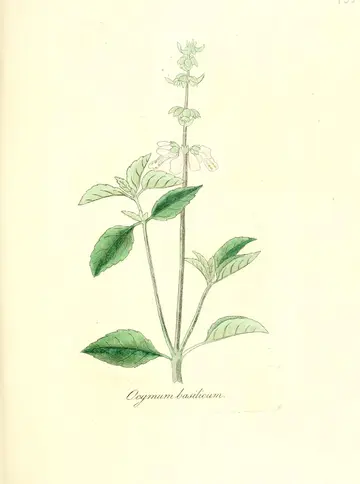
Description
Form
herbaceous, perennial
Height: Up to 1 m
Flower colour
WhitePink
Flowering
June–August
Habitat
Leaves
Opposite, egg-shaped, round-toothed, slightly wrinkled leaves that smell of lemon when crushed. The stem is square.
Flowers
Small, white or pale pink, two-lipped, nectar-rich flowers in the leaf axils in summer.
Fruit and seeds
A small dry fruit that splits into four nutlets.
Classification
- KingdomPlantae
- PhylumTracheophyta
- ClassMagnoliopsida
- OrderLamiales
- FamilyLamiaceae
- GenusMelissa
- SpeciesMelissa officinalis
Native range
According to POWO it is native to the Mediterranean basin, Türkiye, the Caucasus, the Middle East, Iran, Iraq and Central Asia (Turkmenistan, Uzbekistan, Tajikistan, Kyrgyzstan). It has naturalised worldwide.
Growing conditions
Light
Sun or part shade.
Water
Moderate; likes moist soil.
Soil
Fertile, moist soil.
Temperature
Hardy.
Grows easily from seed or root pieces and spreads fast.
Culture and history
The bees' herb
According to Wikipedia it has been grown to attract bees since at least the 16th century; its Turkish name, "oğulotu", means "swarm herb". The lemon scent comes from the volatile compounds geranial and neral.
Toxicity
ASPCA lists lemon balm as non-toxic to cats, dogs and horses.
In an emergency call your local poison centre; for pets, contact a vet straight away. See also: plants and pets.
Look-alikes
- Spearmint: Same family; its leaves are more pointed and smell of mint, and its flowers are in spike-like clusters. Compare side by side →
- Dead-nettles (Lamium species): Similar leaves but no lemon scent, and larger, showier flowers.
Questions
Is lemon balm toxic to cats?
No. ASPCA lists lemon balm as non-toxic to cats, dogs and horses.
Lemon balm: when does it flower?
In summer: June–August. Months are for temperate northern-hemisphere climates and shift with altitude and weather.
Lemon balm: how do you grow it?
Light: Sun or part shade. Water: Moderate; likes moist soil. Soil: Fertile, moist soil. Temperature: Hardy.
Lemon balm: how do you propagate it?
Grows easily from seed or root pieces and spreads fast.
Lemon balm: what is its scientific name?
Melissa officinalis L., in the genus Melissa and the family Lamiaceae.
Sources
- Wikipedia: Lemon balm
- ASPCA Animal Poison Control: Lemon Balm
- World Flora Online
- Plants of the World Online (Kew) · native range (WCVP)
- GBIF · classification
- Wikidata
Checked: 2026-11-17. Spotted a mistake? Tell us.