Description
Form
herb (tuber), perennial
Height: 30–50 cm
Flower colour
GreenYellow
Flowering
April–May
Habitat
Leaves
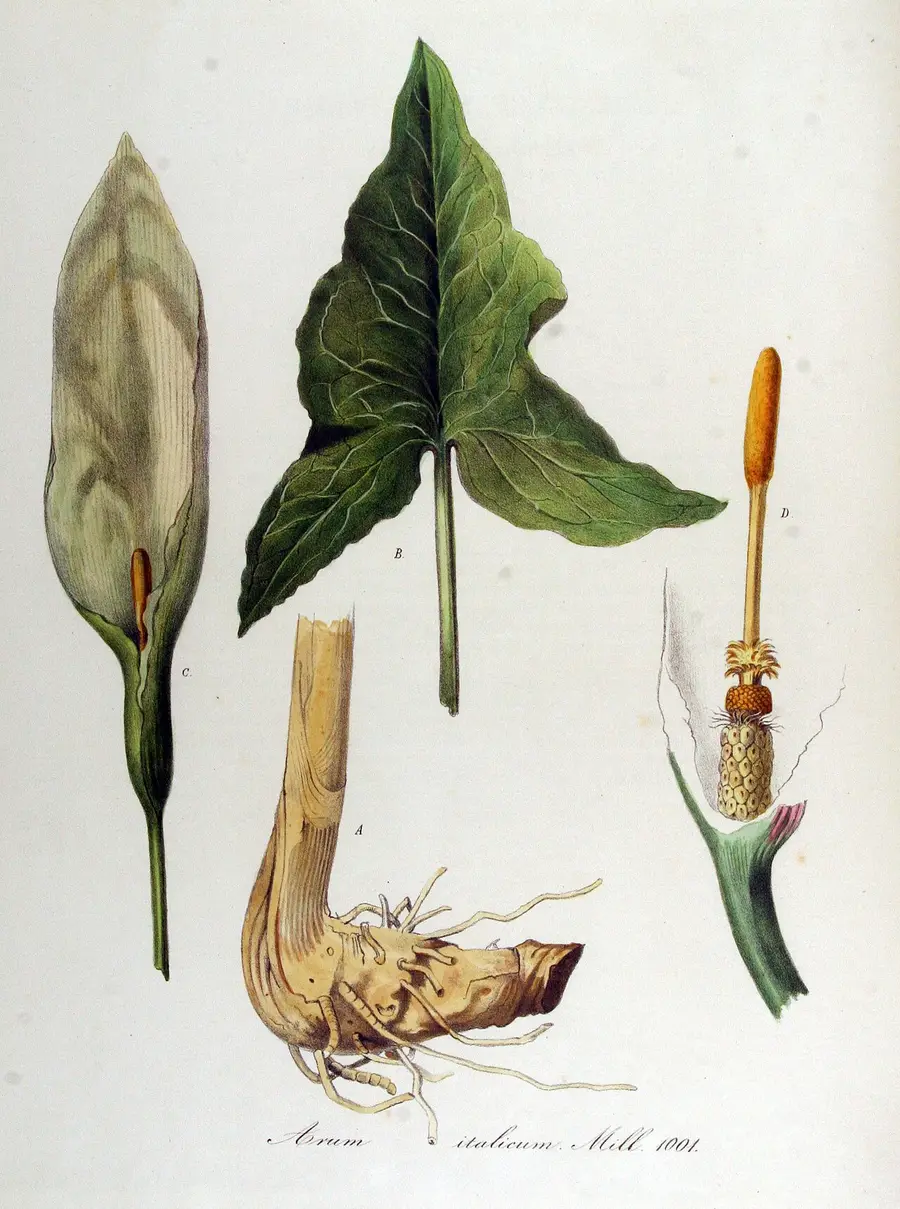
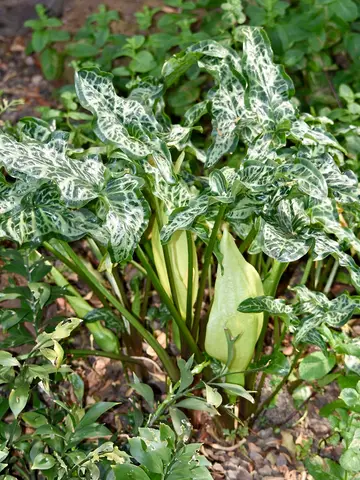
Leaves appear in autumn; arrow- or spear-shaped, dark green with whitish veins.
Flowers
In spring, a yellow spadix inside a pale yellowish-green, funnel-shaped spathe.
Fruit and seeds
In early summer, after the leaves die back, a spike of bright orange-red berries remains at the top of the stalk.
Classification
- KingdomPlantae
- PhylumTracheophyta
- ClassLiliopsida
- OrderAlismatales
- FamilyAraceae
- GenusArum
- SpeciesArum italicum
Native range
According to POWO it is native to most of the Mediterranean Basin, Macaronesia, southern Britain, Crimea, Türkiye, Lebanon–Syria and Iraq.
Toxicity
Like most of the arum family, all parts contain needle-shaped calcium oxalate crystals and irritants. Chewing causes severe burning and swelling of the mouth, tongue and throat; swallowing can cause vomiting and diarrhoea. The bright berries are a particular risk for children. Never pick or eat a wild plant unless you are certain what it is. If poisoning is suspected, call your local poison centre or emergency number at once.
In an emergency call your local poison centre; for pets, contact a vet straight away. See also: plants and pets.
Look-alikes
- Lords-and-ladies (Arum maculatum): Its leaves are often black-spotted, without white veins; it is equally poisonous.
- Dumb cane: A houseplant of the same family that causes the same kind of mouth swelling. Compare side by side →
Questions
Are Italian arum berries poisonous?
Yes. All parts, including the bright red berries, contain calcium oxalate crystals that cause severe burning and swelling of the mouth.
Italian arum: when does it flower?
In spring: April–May. Months are for temperate northern-hemisphere climates and shift with altitude and weather.
Italian arum: what is its scientific name?
Arum italicum Mill., in the genus Arum and the family Araceae.
Sources
- Wikipedia: Arum italicum
- World Flora Online
- Plants of the World Online (Kew) · native range (WCVP)
- GBIF · classification
- Wikidata
Checked: 2026-11-16. Spotted a mistake? Tell us.