
Description
Form
herb, perennial, evergreen
Height: 30–60 cm
Flower colour
RedPinkWhite
Flowering
No reliable data in the sources.
Habitat
Leaves
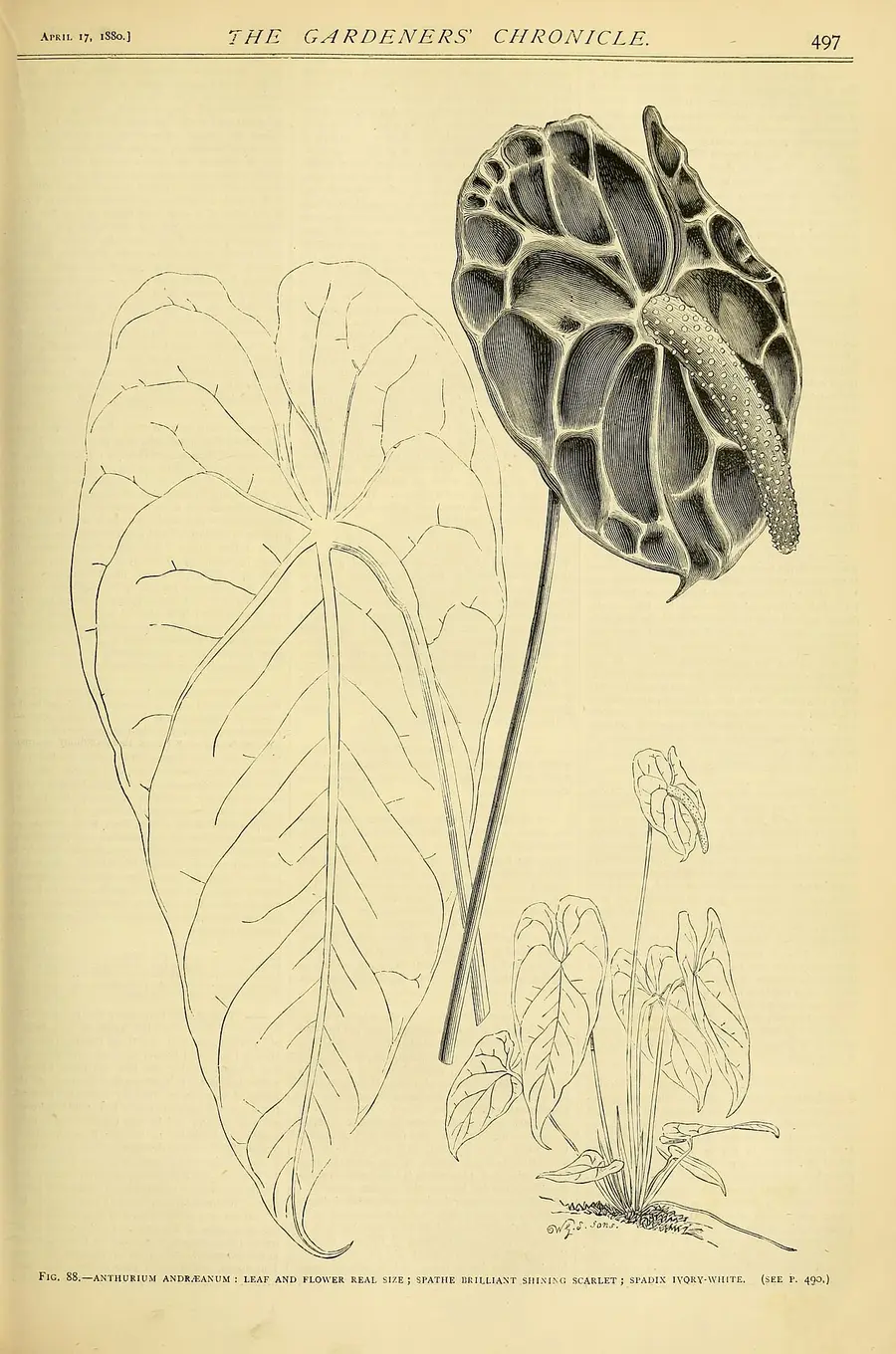
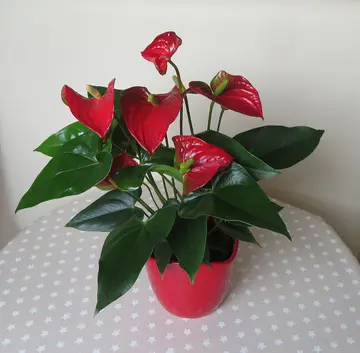
Long-stalked, heart-shaped, glossy dark green leaves.
Flowers
The true flowers are tiny, packed onto an upright spadix; the shiny heart-shaped "petal" at its base is a spathe (a modified leaf).
Fruit and seeds
Small berries; rarely indoors.

Classification
- KingdomPlantae
- PhylumTracheophyta
- ClassLiliopsida
- OrderAlismatales
- FamilyAraceae
- GenusAnthurium
- SpeciesAnthurium andraeanum
Native range
According to POWO it is native to Colombia and Ecuador, where it grows mostly on trees or rocks in humid mountain forest. Most anthuriums sold are hybrid cultivars bred from this species.
Care
Light
Bright, indirect light. Direct sun burns the leaves; in low light it will not flower.
Water
When the top 2–3 cm of soil are dry; no water in the saucer.
Soil
A very airy mix such as bark, perlite and peat (it is an epiphyte).
Temperature
18–27 °C; dislikes temperatures below 15 °C.
Likes humid air; standing the pot on a tray of wet gravel helps.
Culture and history
The name
Anthurium comes from the Greek anthos (flower) and oura (tail), after the tail-like spadix.
Toxicity
All parts contain saponins and needle-like calcium oxalate crystals. Chewing causes painful burning and swelling of the mouth and throat, drooling and vomiting.
In an emergency call your local poison centre; for pets, contact a vet straight away. See also: plants and pets.
Look-alikes
- Peace lily: A relative with a white, hooded spathe and matt green leaves. Compare side by side →
Questions
Why is my anthurium not flowering?
Usually too little light; it needs bright, indirect light (not direct sun) to flower.
Anthurium: how do you care for it?
Light: Bright, indirect light. Direct sun burns the leaves; in low light it will not flower. Water: When the top 2–3 cm of soil are dry; no water in the saucer. Soil: A very airy mix such as bark, perlite and peat (it is an epiphyte). Temperature: 18–27 °C; dislikes temperatures below 15 °C. Likes humid air; standing the pot on a tray of wet gravel helps.
Anthurium: is it toxic to cats and dogs?
Toxic to cats and dogs; Mildly toxic / irritant to people. Calcium oxalate; mouth irritation.
Anthurium: what is its scientific name?
Anthurium andraeanum Linden ex André, in the genus Anthurium and the family Araceae.
Sources
- Wikipedia: Anthurium andraeanum
- World Flora Online
- Plants of the World Online (Kew) · native range (WCVP)
- GBIF · classification
- Wikidata
Checked: 2026-11-16. Spotted a mistake? Tell us.