Description
Form
climber, perennial, evergreen
Height: 0.5–1.5 m in a pot; climbs trees to 10 m in the wild
Flowering
No reliable data in the sources.
Habitat
Leaves
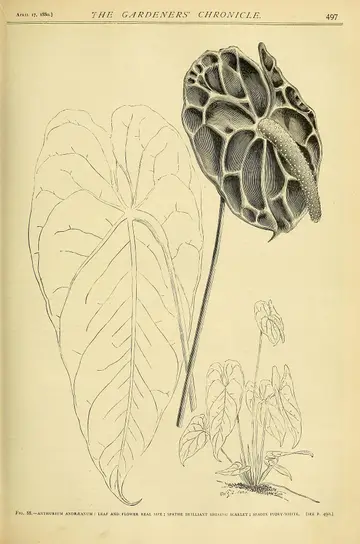
Young leaves are arrowhead-shaped and often variegated white, cream or pink; older leaves are split into 5–11 segments and dark green. Aerial roots grow from the stem.
Flowers
It rarely flowers in a pot; the arum-type spike sits inside a greenish-white bract (spathe).
Classification
- KingdomPlantae
- PhylumTracheophyta
- ClassLiliopsida
- OrderAlismatales
- FamilyAraceae
- GenusSyngonium
- SpeciesSyngonium podophyllum
Native range
According to POWO it is native to tropical America, from Mexico through Central America to Colombia, Ecuador, Bolivia, the Guianas and Brazil. It has become invasive in Florida and on some Pacific islands.
Care
Light
Medium to bright, indirect light.
Water
When the top 2–3 cm of soil is dry.
Soil
Airy, free-draining potting compost.
Temperature
18–27 °C.
Given a moss pole to climb, it grows larger leaves; pinching out the tips keeps it bushy.
Toxicity
ASPCA lists it as toxic to cats, dogs and horses. The plant contains insoluble calcium oxalate crystals; chewing it causes burning and irritation of the mouth, drooling, vomiting and difficulty swallowing. It can also irritate the mouth and skin in people.
In an emergency call your local poison centre; for pets, contact a vet straight away. See also: plants and pets.
Look-alikes
- Philodendron: Also a climbing arum relative, but its leaves are heart-shaped and do not split with age. Compare side by side →
Questions
Why do arrowhead plant leaves change shape?
Young plants make arrowhead-shaped leaves; as they climb and mature they make leaves split like a hand. In pots they usually stay in the young form.
Is the arrowhead plant toxic to cats?
Yes. ASPCA lists it as toxic to cats, dogs and horses.
Arrowhead plant: how do you care for it?
Light: Medium to bright, indirect light. Water: When the top 2–3 cm of soil is dry. Soil: Airy, free-draining potting compost. Temperature: 18–27 °C.
Arrowhead plant: when and how do you prune it?
Given a moss pole to climb, it grows larger leaves; pinching out the tips keeps it bushy.
Arrowhead plant: what is its scientific name?
Syngonium podophyllum Schott, in the genus Syngonium and the family Araceae.
Sources
- Wikipedia: Syngonium podophyllum
- World Flora Online
- Plants of the World Online (Kew) · native range (WCVP)
- GBIF · classification
- Wikidata
- ASPCA Animal Poison Control: Nephthytis (Syngonium podophyllum)
Checked: 2026-11-16. Spotted a mistake? Tell us.