Description
Form
herb, perennial, evergreen
Height: Potted 60–150 cm
Flower colour
GreenWhite
Flowering
No reliable data in the sources.
Habitat
Leaves
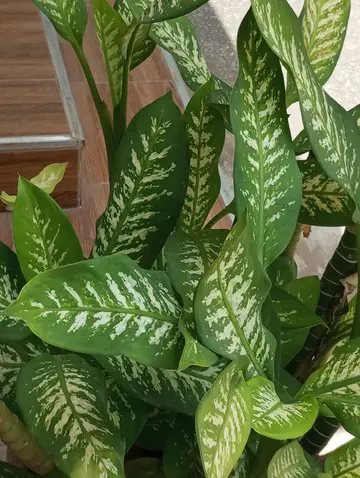
Large, oval, long-stalked leaves, in most cultivars blotched and veined with cream, white or pale green. The stem is thick and cane-like.
Flowers
A cream spadix wrapped in a greenish spathe; rarely seen indoors.
Classification
- KingdomPlantae
- PhylumTracheophyta
- ClassLiliopsida
- OrderAlismatales
- FamilyAraceae
- GenusDieffenbachia
- SpeciesDieffenbachia seguine
Native range
According to POWO it is native to the Caribbean islands (Cuba, Jamaica, Haiti, Puerto Rico, Trinidad) and northern to central South America (Venezuela, the Guianas, Colombia, Ecuador, Peru, Bolivia, Brazil), on the shady floor of humid forests.
Care
Light
Medium to bright indirect light. In low light the pattern fades and the stem stretches.
Water
When the top 2–3 cm of soil are dry; no water in the saucer.
Soil
Humus-rich, free-draining mix.
Temperature
16–29 °C; dislikes cold draughts.
Wear gloves when pruning or propagating and keep the sap away from eyes and mouth. Leggy stems can be cut and rooted as cuttings.
Culture and history
The name
The genus honours Joseph Dieffenbach, a 19th-century head gardener at the Schönbrunn Palace in Vienna.
Toxicity
All parts contain insoluble calcium oxalate needles and a protein-digesting enzyme. Chewing causes severe burning and swelling of the mouth, tongue and throat, drooling and difficulty swallowing; the swelling can rarely make breathing difficult. The sap also irritates the eyes. ASPCA lists it as toxic to cats and dogs.
In an emergency call your local poison centre; for pets, contact a vet straight away. See also: plants and pets.
Look-alikes
- Chinese evergreen: A smaller relative with narrower leaves on short stems. Compare side by side →
Questions
Why is Dieffenbachia called dumb cane?
Chewing it makes the mouth and tongue swell so painfully that speaking becomes difficult; the plant is toxic to people and pets.
Dumb cane: how do you care for it?
Light: Medium to bright indirect light. In low light the pattern fades and the stem stretches. Water: When the top 2–3 cm of soil are dry; no water in the saucer. Soil: Humus-rich, free-draining mix. Temperature: 16–29 °C; dislikes cold draughts.
Dumb cane: how do you propagate it?
Wear gloves when pruning or propagating and keep the sap away from eyes and mouth. Leggy stems can be cut and rooted as cuttings.
Dumb cane: is it toxic to cats and dogs?
Toxic to cats and dogs and people. Calcium oxalate; severe mouth swelling.
Dumb cane: what is its scientific name?
Dieffenbachia seguine (Jacq.) Schott, in the genus Dieffenbachia and the family Araceae.
Sources
- Wikipedia: Dieffenbachia seguine
- World Flora Online
- Plants of the World Online (Kew) · native range (WCVP)
- GBIF · classification
- Wikidata
- ASPCA Animal Poison Control: Dieffenbachia
- Wikipedia: Dieffenbachia (cins)
Checked: 2026-11-16. Spotted a mistake? Tell us.