Telling them apart
Dumb cane vs Italian arum
Dumb cane (Dieffenbachia seguine) and Italian arum (Arum italicum) look similar enough to be confused. Both belong to the same family, Araceae (arum family).
CautionDumb cane and Italian arum are poisonous to people. Never pick or eat a wild plant unless you are certain of its identity. If poisoning is suspected, call your local poison centre or emergency number.
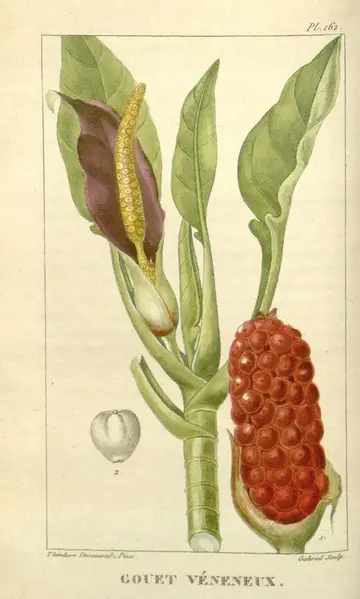
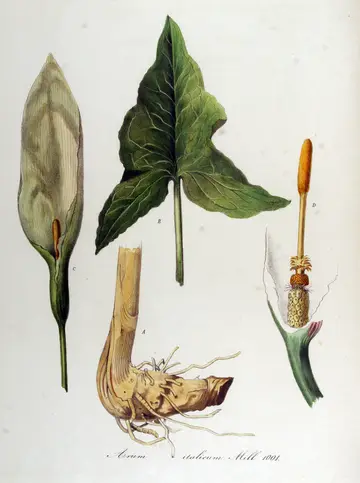
How to tell them apart
- Dumb cane: A houseplant of the same family that causes the same kind of mouth swelling.
Side by side
| Dumb cane | Italian arum | |
|---|---|---|
| Scientific name | Dieffenbachia seguine | Arum italicum |
| Family | Araceae (arum family) | Araceae (arum family) |
| Form | herb, perennial, evergreen | herb (tuber), perennial |
| Height | Potted 60–150 cm | 30–50 cm |
| Flower colour | Green, White | Green, Yellow |
| Origin | Caribbean and tropical South America | Mediterranean, western Asia and southern Britain |
| Toxicity | People: toxic · Cats: toxic · Dogs: toxic | People: toxic · Cats: toxic · Dogs: toxic |
| Flowering | — | |
| Leaves | Large, oval, long-stalked leaves, in most cultivars blotched and veined with cream, white or pale green. The stem is thick and cane-like. | Leaves appear in autumn; arrow- or spear-shaped, dark green with whitish veins. |
| Flowers | A cream spadix wrapped in a greenish spathe; rarely seen indoors. | In spring, a yellow spadix inside a pale yellowish-green, funnel-shaped spathe. |
| Fruit and seeds | — | In early summer, after the leaves die back, a spike of bright orange-red berries remains at the top of the stalk. |
All pairs: look-alike plants · Full pages: Dumb cane, Italian arum