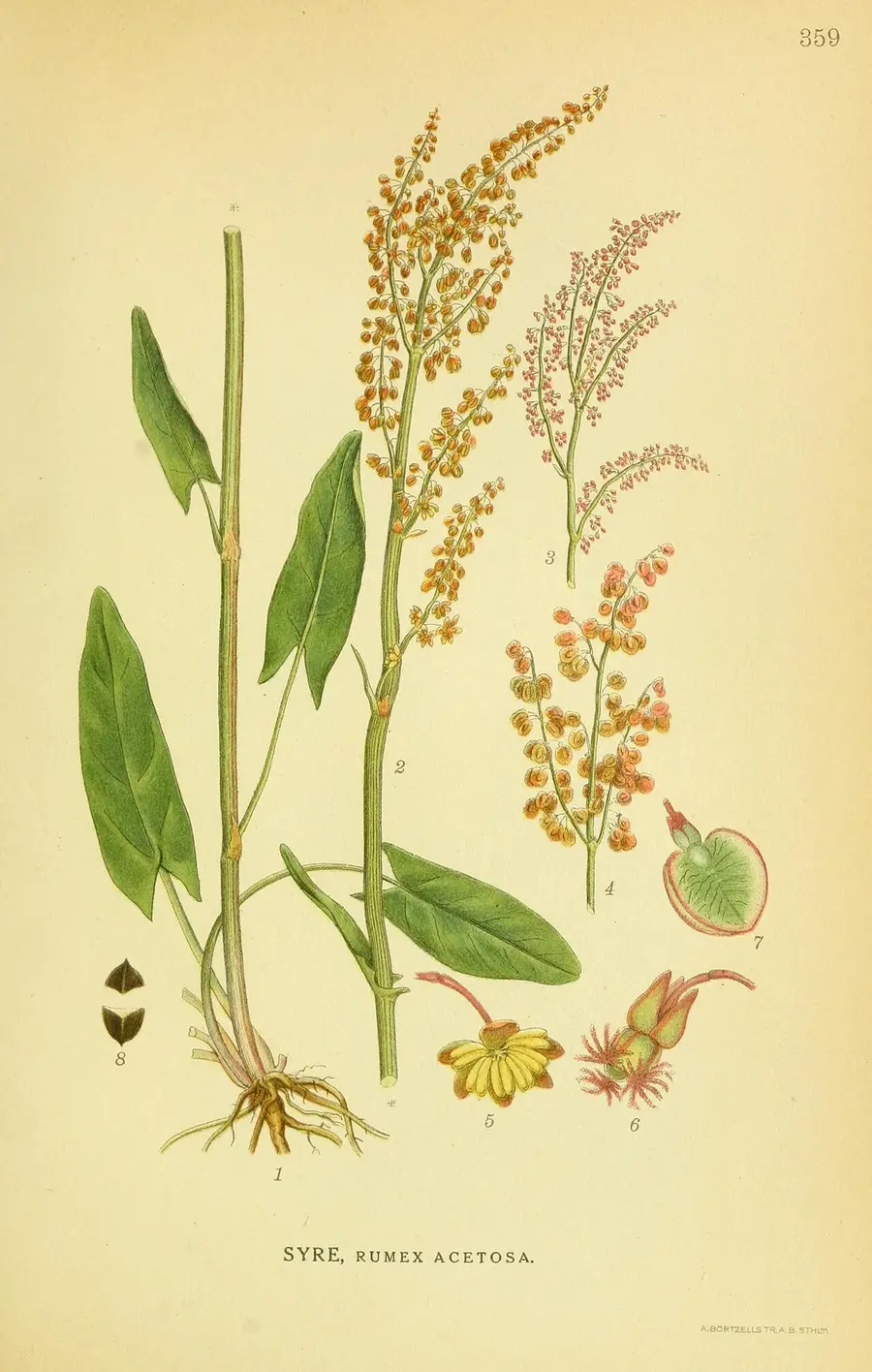

Description
Form
herbaceous, perennial
Height: 30–100 cm
Flower colour
RedGreen
Flowering
May–July
Leaves
Arrow-shaped leaves with two pointed, downward-facing lobes where the stalk joins. Stem leaves are stalkless and clasp the stem.
Flowers
Small, reddish-green flowers in branching spikes at the stem tip; male and female flowers are on separate plants.
Fruit and seeds
Small three-sided fruits enclosed in reddish, papery wings.
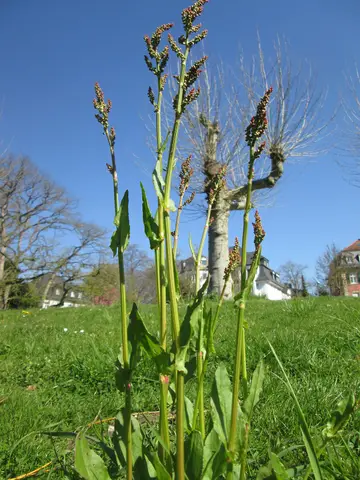

Classification
- KingdomPlantae
- PhylumTracheophyta
- ClassMagnoliopsida
- OrderCaryophyllales
- FamilyPolygonaceae
- GenusRumex
- SpeciesRumex acetosa
Native range
According to POWO it is native throughout Europe and temperate Asia east to Central Asia, Siberia, China and Japan. It has been carried to North America and parts of South America.
Toxicity
The leaves contain soluble oxalates (oxalic acid). ASPCA lists sorrel (the entry is for the related Rumex scutatus) as toxic to cats, dogs and horses; signs are vomiting, diarrhoea, weakness, low blood calcium and kidney damage. Eating large amounts can also harm people.
In an emergency call your local poison centre; for pets, contact a vet straight away. See also: plants and pets.
Look-alikes
- Cuckoo-pint (Arum): Young Arum leaves are also arrow-shaped and can be mistaken for sorrel, but they are glossier, net-veined and wavy-edged. Arum leaves cause severe burning and swelling of the mouth. Never pick or eat wild plants unless you are certain of their identity. If poisoning is suspected, call your local poison centre (in Türkiye, 114). Compare side by side →
Questions
Why is sorrel sour?
Its leaves contain oxalic acid and oxalates. These are toxic to pets; ASPCA lists sorrel as toxic to cats, dogs and horses.
Common sorrel: when does it flower?
In spring and summer: May–July. Months are for temperate northern-hemisphere climates and shift with altitude and weather.
Common sorrel: is it toxic to cats and dogs?
Toxic to cats and dogs. Soluble oxalates: can cause kidney damage.
Common sorrel: what is its scientific name?
Rumex acetosa L., in the genus Rumex and the family Polygonaceae.
Sources
- Wikipedia: Rumex acetosa
- World Flora Online
- Plants of the World Online (Kew) · native range (WCVP)
- GBIF · classification
- Wikidata
- Wikipedia
- ASPCA Animal Poison Control: Sorrel (Rumex scutatus)
Checked: 2026-11-17. Spotted a mistake? Tell us.