Telling them apart
Common sorrel vs Italian arum
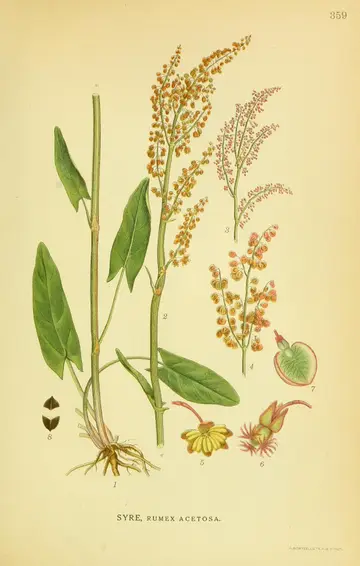
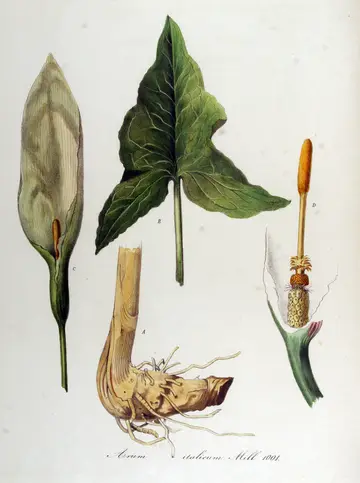
Common sorrel (Rumex acetosa) and Italian arum (Arum italicum) look similar enough to be confused. They belong to different families: Polygonaceae (knotweed family) and Araceae (arum family).
CautionItalian arum is poisonous to people. Never pick or eat a wild plant unless you are certain of its identity. If poisoning is suspected, call your local poison centre or emergency number.
How to tell them apart
- Italian arum: Young Arum leaves are also arrow-shaped and can be mistaken for sorrel, but they are glossier, net-veined and wavy-edged. Arum leaves cause severe burning and swelling of the mouth. Never pick or eat wild plants unless you are certain of their identity. If poisoning is suspected, call your local poison centre (in Türkiye, 114).
Side by side
| Common sorrel | Italian arum | |
|---|---|---|
| Scientific name | Rumex acetosa | Arum italicum |
| Family | Polygonaceae (knotweed family) | Araceae (arum family) |
| Form | herbaceous, perennial | herb (tuber), perennial |
| Height | 30–100 cm | 30–50 cm |
| Flower colour | Red, Green | Green, Yellow |
| Origin | Europe and temperate Asia | Mediterranean, western Asia and southern Britain |
| Toxicity | Cats: toxic · Dogs: toxic | People: toxic · Cats: toxic · Dogs: toxic |
| Flowering | ||
| Leaves | Arrow-shaped leaves with two pointed, downward-facing lobes where the stalk joins. Stem leaves are stalkless and clasp the stem. | Leaves appear in autumn; arrow- or spear-shaped, dark green with whitish veins. |
| Flowers | Small, reddish-green flowers in branching spikes at the stem tip; male and female flowers are on separate plants. | In spring, a yellow spadix inside a pale yellowish-green, funnel-shaped spathe. |
| Fruit and seeds | Small three-sided fruits enclosed in reddish, papery wings. | In early summer, after the leaves die back, a spike of bright orange-red berries remains at the top of the stalk. |
All pairs: look-alike plants · Full pages: Common sorrel, Italian arum