Description
Form
climber, perennial, evergreen
Height: Climbs to 20–30 m
Flower colour
GreenYellow
Flowering
September–November
Habitat
Leaves
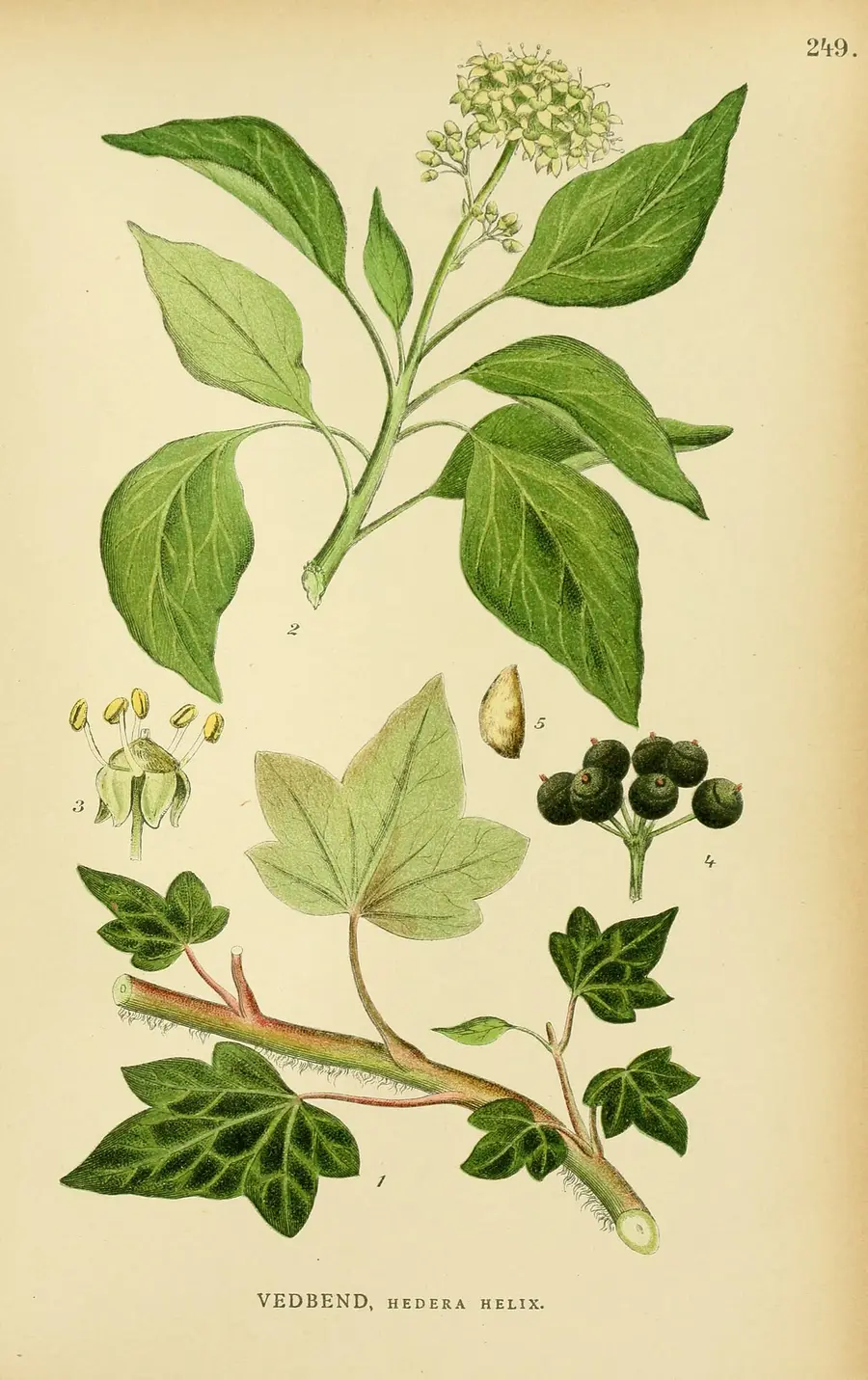
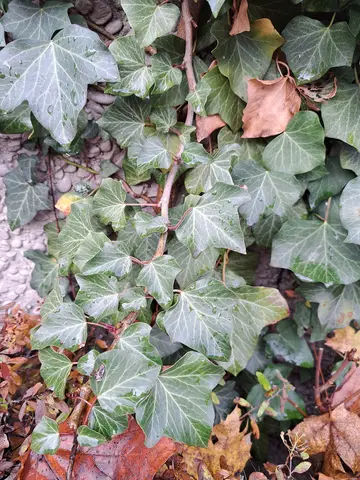
Leaves on young climbing shoots are 3- to 5-lobed and dark green. On mature flowering shoots they are unlobed and egg-shaped.
Flowers
In autumn, small balls of greenish-yellow flowers open at the tips of mature shoots; they are one of the last nectar sources of the season.
Fruit and seeds
Small, black berries that ripen in winter; an important winter food for birds.
Classification
- KingdomPlantae
- PhylumTracheophyta
- ClassMagnoliopsida
- OrderApiales
- FamilyAraliaceae
- GenusHedera
- SpeciesHedera helix
Native range
According to POWO it is native to most of Europe, Türkiye, the Caucasus and parts of North Africa. It has become invasive in parts of North America and Australia.
Care
Light
Shade to part shade; bright indirect light in a pot.
Water
Moderate; when the top of the soil is dry.
Soil
Any soil.
Temperature
Hardy; in a pot it likes cool rooms, and spider mites appear in warm, dry air.
Culture and history
The plant of Dionysus
In ancient Greece ivy was the symbol of Dionysus, god of wine, who is often shown wearing an ivy wreath.
Does it harm trees?
Ivy is not a parasite: its aerial roots only cling and take no food from the tree. But a dense cover can shade the crown and increase the wind load.
Toxicity
ASPCA lists it as toxic to cats, dogs and horses. The toxins are triterpenoid saponins (hederagenin); signs are vomiting, abdominal pain, drooling and diarrhoea. The leaves are more toxic than the berries. In people, eating the berries can cause vomiting and diarrhoea, and the sap can cause a skin rash in some people.
In an emergency call your local poison centre; for pets, contact a vet straight away. See also: plants and pets.
Look-alikes
- Persian ivy (Hedera colchica): A relative native to the Black Sea region, with much larger, often unlobed leaves.
- Virginia creeper and Boston ivy (Parthenocissus): Other wall-covering climbers; their leaves turn red and fall in autumn, and their tendrils end in sticky pads.
Questions
Does ivy harm trees?
It is not a parasite and takes no food from the tree. But a dense cover can shade the crown and add to its load in storms.
Is ivy toxic to cats?
Yes. ASPCA lists it as toxic; it contains saponins that cause vomiting and diarrhoea.
Common ivy: when does it flower?
In autumn: September–November. Months are for temperate northern-hemisphere climates and shift with altitude and weather.
Common ivy: how do you care for it?
Light: Shade to part shade; bright indirect light in a pot. Water: Moderate; when the top of the soil is dry. Soil: Any soil. Temperature: Hardy; in a pot it likes cool rooms, and spider mites appear in warm, dry air.
Common ivy: what is its scientific name?
Hedera helix L., in the genus Hedera and the family Araliaceae.
Sources
- Wikipedia: Hedera helix
- World Flora Online
- Plants of the World Online (Kew) · native range (WCVP)
- GBIF · classification
- Wikidata
- ASPCA Animal Poison Control: English Ivy (Hedera helix)
Checked: 2026-11-17. Spotted a mistake? Tell us.