Description
Form
herbaceous succulent, perennial, evergreen
Height: Rosettes 3–10 cm; flowering stalk 20–40 cm
Flower colour
PinkPurple
Flowering
July–August
Leaves
Fleshy, pointed leaves with finely hairy margins, often reddish at the tips, packed into tight rosettes.
Flowers
Star-shaped, pinkish-purple flowers in clusters on a fleshy stalk rising from the centre of the rosette. A rosette that flowers dies after setting seed and is replaced by its offsets.
Fruit and seeds
Small, dry, many-seeded capsules.
Classification
- KingdomPlantae
- PhylumTracheophyta
- ClassMagnoliopsida
- OrderSaxifragales
- FamilyCrassulaceae
- GenusSempervivum
- SpeciesSempervivum tectorum
Native range
According to POWO it is native to the mountains of Spain, France, Switzerland, Austria, Germany, Italy, Hungary and the Balkans.
Growing conditions
Light
Full sun.
Water
Very little; very drought tolerant.
Soil
Cactus and succulent compost, or a very free-draining mix with added grit or perlite.
Temperature
Very hardy to cold and frost.
Easily propagated by detaching the offset rosettes.
Culture and history
Protection from lightning
In medieval Europe houseleeks were believed to protect roofs from lightning and were planted on them; the Latin name tectorum ("of the roofs") comes from this.
Look-alikes
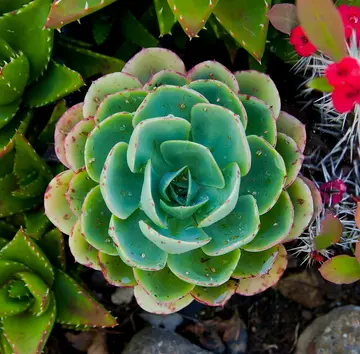
- Mexican snowball (Echeveria): Similar rosettes, but larger, with rounder, powdery leaves; it is not frost hardy and has nodding, bell-shaped flowers. Compare side by side →
Questions
Can houseleeks stay outdoors in winter?
Yes. They are very hardy to frost and snow; the real danger in winter is water sitting in the soil.
Common houseleek: when does it flower?
In summer: July–August. Months are for temperate northern-hemisphere climates and shift with altitude and weather.
Common houseleek: how do you grow it?
Light: Full sun. Water: Very little; very drought tolerant. Soil: Cactus and succulent compost, or a very free-draining mix with added grit or perlite. Temperature: Very hardy to cold and frost.
Common houseleek: how do you propagate it?
Easily propagated by detaching the offset rosettes.
Common houseleek: what is its scientific name?
Sempervivum tectorum L., in the genus Sempervivum and the family Crassulaceae.
Sources
- Wikipedia: Sempervivum tectorum
- World Flora Online
- Plants of the World Online (Kew) · native range (WCVP)
- GBIF · classification
- Wikidata
Checked: 2026-11-16. Spotted a mistake? Tell us.