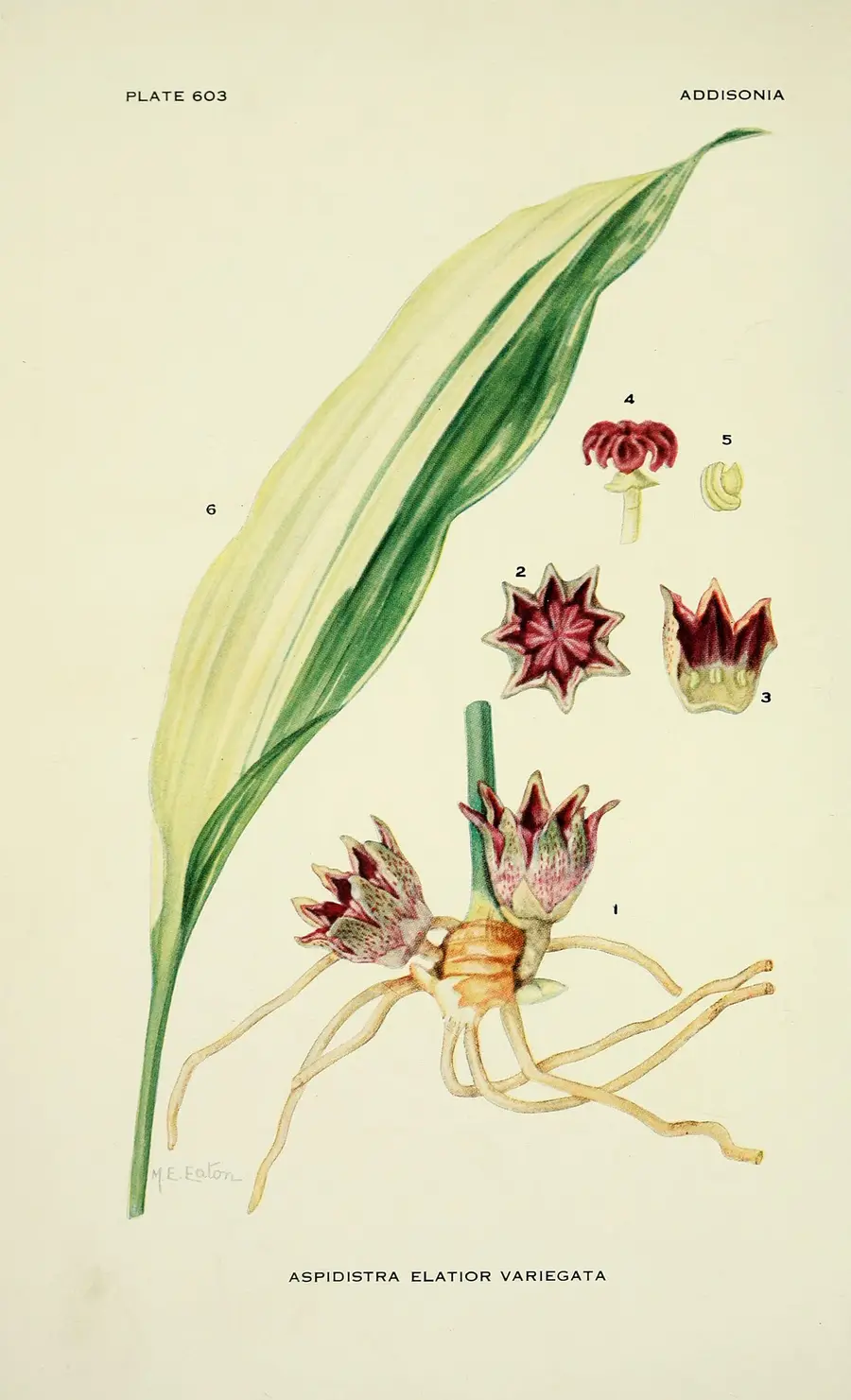
Description
Form
herbaceous, perennial, evergreen
Height: 50–80 cm
Flower colour
Purple
Flowering
No reliable data in the sources.
Habitat
Leaves
Leaves rise singly from an underground stem; they are long-stalked, lance-shaped, dark green and glossy.
Flowers
Small, fleshy, dark purple flowers at ground level, hidden at the base of the leaves.
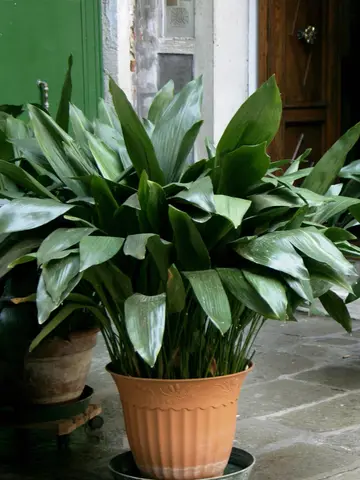
Classification
- KingdomPlantae
- PhylumTracheophyta
- ClassLiliopsida
- OrderAsparagales
- FamilyAsparagaceae
- GenusAspidistra
- SpeciesAspidistra elatior
Native range
According to POWO its native range is Japan, where it grows on the shady floor of forests on the southern islands.
Care
Light
Low light; direct sun scorches the leaves.
Water
Low to moderate; dislikes too much water.
Soil
Any free-draining soil.
Temperature
5–25 °C; tolerates cold hallways and stairwells.
Grows very slowly. Propagate by dividing the rhizome.
Culture and history
The Victorian plant
In 19th-century Britain it became very common as one of the few plants that could survive in dim parlours filled with smoke from gas lamps.
Toxicity
ASPCA lists the cast-iron plant as non-toxic to cats, dogs and horses.
In an emergency call your local poison centre; for pets, contact a vet straight away. See also: plants and pets.
Look-alikes
- Peace lily: Similar leaves, but thinner with curled tips; it bears white hooded flowers and is an irritant to cats. Compare side by side →
Questions
Is the cast-iron plant safe for cats?
ASPCA lists it as non-toxic to cats, dogs and horses.
Cast-iron plant: how do you care for it?
Light: Low light; direct sun scorches the leaves. Water: Low to moderate; dislikes too much water. Soil: Any free-draining soil. Temperature: 5–25 °C; tolerates cold hallways and stairwells. Grows very slowly.
Cast-iron plant: how do you propagate it?
Propagate by dividing the rhizome.
Cast-iron plant: is it toxic to cats and dogs?
Non-toxic to cats and dogs. Non-toxic to pets (ASPCA).
Cast-iron plant: what is its scientific name?
Aspidistra elatior Blume, in the genus Aspidistra and the family Asparagaceae.
Sources
- Wikipedia: Aspidistra elatior
- World Flora Online
- Plants of the World Online (Kew) · native range (WCVP)
- GBIF · classification
- Wikidata
- ASPCA Animal Poison Control: Cast Iron Plant (Aspidistra elatior)
Checked: 2026-11-16. Spotted a mistake? Tell us.
)_(16585308008).jpg)
