Description
Form
herb (bulb), perennial
Height: 10–15 cm
Flower colour
BluePurpleWhite
Flowering
February–April
Leaves
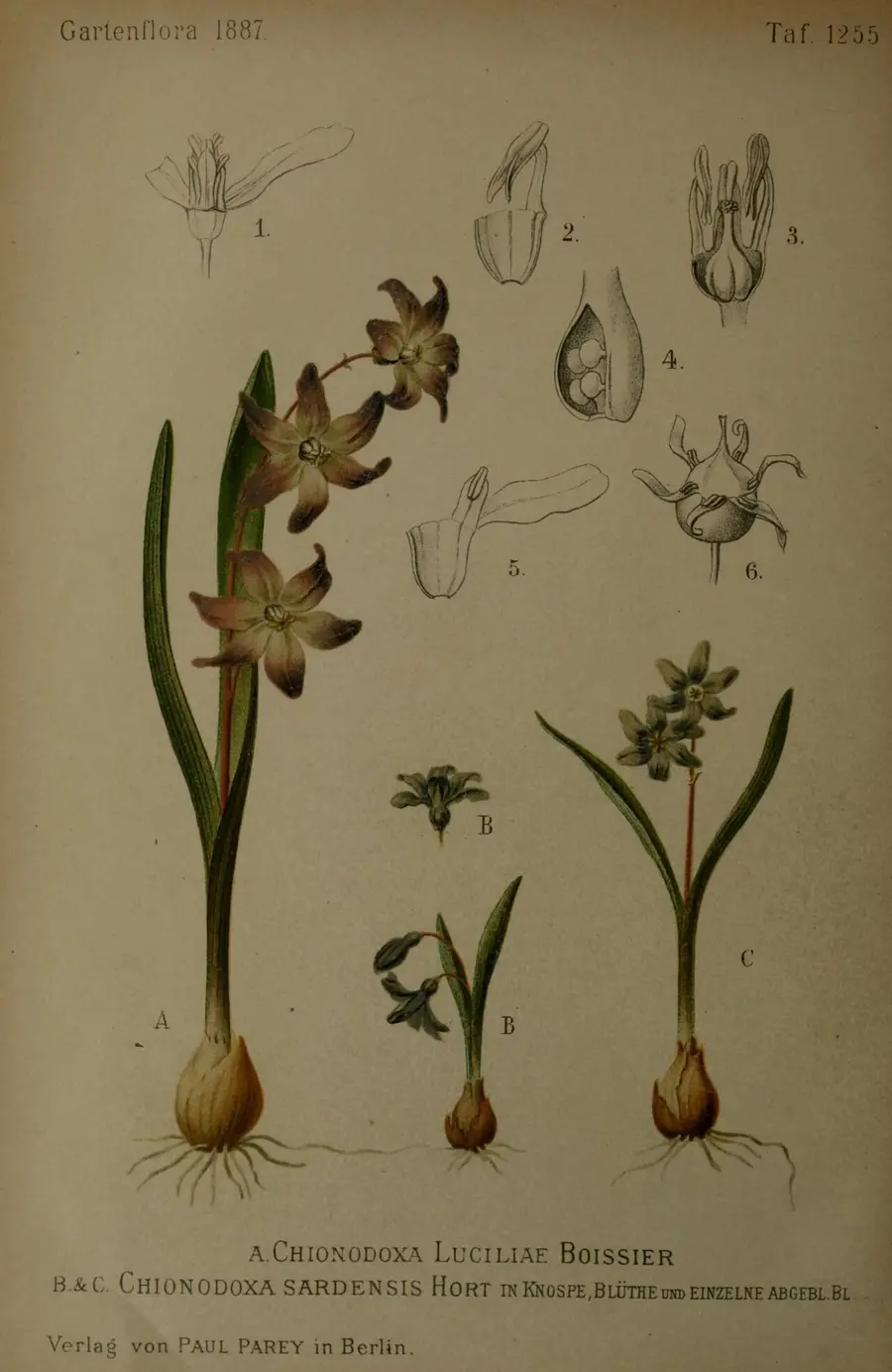
Usually two narrow, strap-shaped leaves per bulb.
Flowers
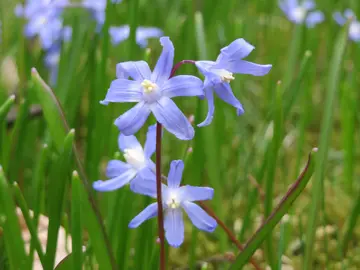
One to three upward-facing, star-shaped flowers per stem, blue-violet with a white centre. The filaments are flattened and pressed together in the centre, a feature of the former genus Chionodoxa.
Fruit and seeds
A small three-chambered capsule; ants carry away the seeds.
Classification
- KingdomPlantae
- PhylumTracheophyta
- ClassLiliopsida
- OrderAsparagales
- FamilyAsparagaceae
- GenusScilla
- SpeciesScilla luciliae
Native range
According to POWO it is native only to Türkiye, in clearings and meadows of the western Anatolian mountains where snow melts early. It has escaped from gardens and naturalised in parts of central Europe, Britain and North America.
Culture and history
The name
Swiss botanist Edmond Boissier described it as Chionodoxa luciliae. "Chionodoxa" comes from the Greek for "snow" and "glory"; "luciliae" honours Boissier's wife Lucile.
Look-alikes
- Scilla forbesii (Chionodoxa forbesii): A related western Anatolian species, far more common in gardens, with more but smaller flowers per stem.
- Siberian squill (Scilla siberica): Its flowers nod downwards and have no white centre.
Questions
Is glory-of-the-snow native to Türkiye?
Yes. Scilla luciliae is endemic to the mountains of western Anatolia, although it now grows in gardens worldwide.
Glory-of-the-snow: when does it flower?
In winter and spring: February–April. Months are for temperate northern-hemisphere climates and shift with altitude and weather.
Glory-of-the-snow: what is its scientific name?
Scilla luciliae (Boiss.) Speta, in the genus Scilla and the family Asparagaceae.
Sources
- Wikipedia: Scilla luciliae
- World Flora Online
- Plants of the World Online (Kew) · native range (WCVP)
- GBIF · classification
- Wikidata
Checked: 2026-11-16. Spotted a mistake? Tell us.