Description
Form
shrub, perennial
Height: 2–5 m (annual and shorter in cold climates)
Flower colour
RedYellow
Flowering
June–September
Leaves
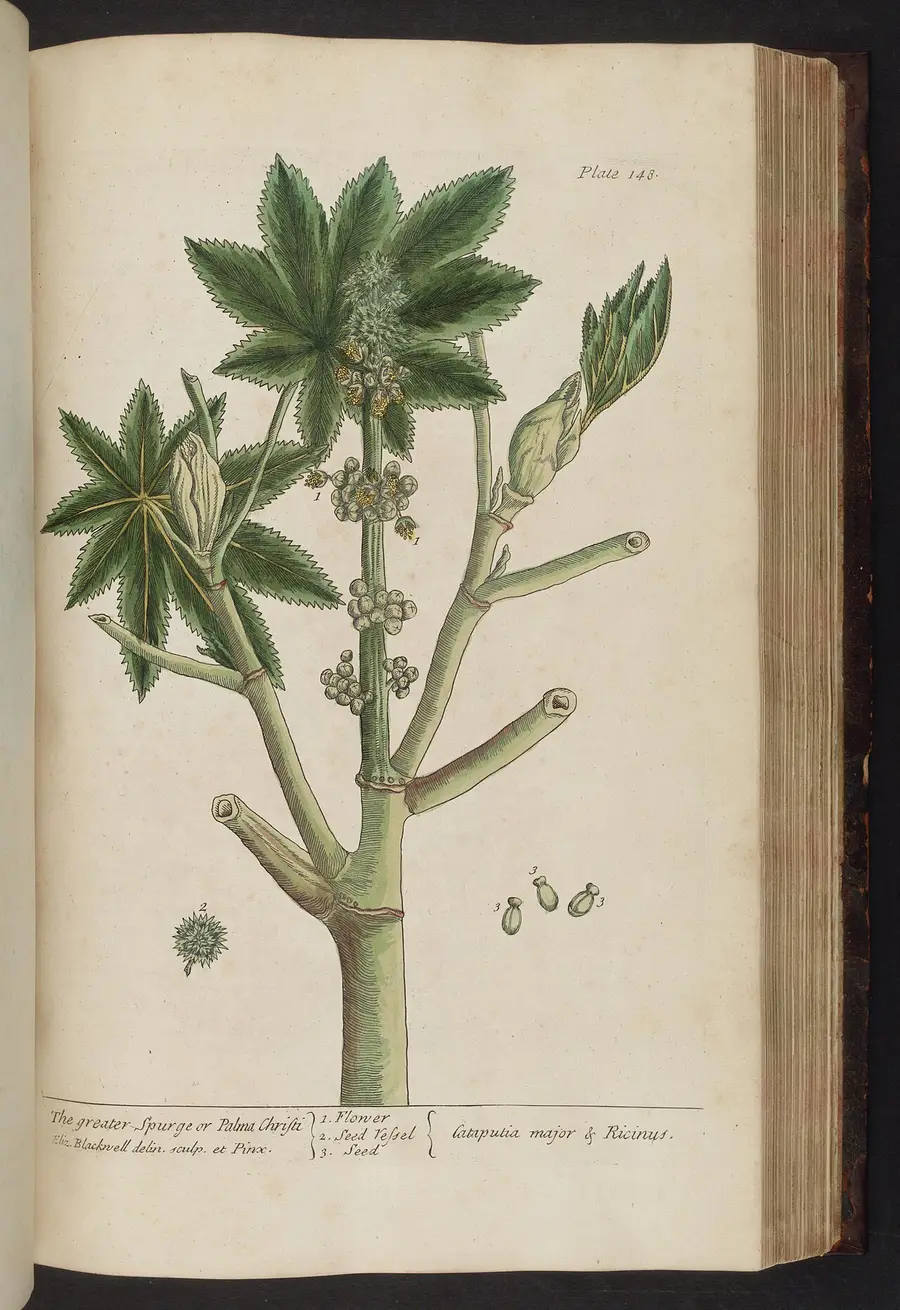
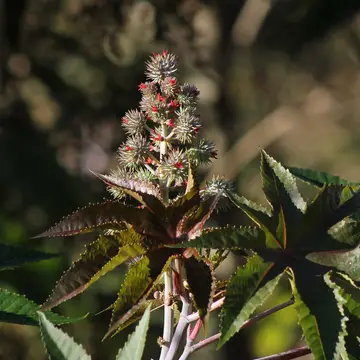
Very large, hand-shaped leaves with 5–11 deep lobes, green or red-purple.
Flowers
Red, feathery female flowers at the top of the spike and yellow male flowers below.
Fruit and seeds
A soft-spined, three-chambered capsule holding glossy, mottled, bean-like seeds.
Classification
- KingdomPlantae
- PhylumTracheophyta
- ClassMagnoliopsida
- OrderMalpighiales
- FamilyEuphorbiaceae
- GenusRicinus
- SpeciesRicinus communis
Native range
According to POWO it is native to Ethiopia, Eritrea and Somalia. It has become wild in most warm regions of the world.
Culture and history
Castor oil
Castor oil is pressed from the seeds; the toxic protein ricin does not pass into the oil but stays in the pressed cake. The oil is used as an industrial lubricant and in paints and cosmetics.
Toxicity
The seeds contain ricin, which stops cells from making proteins. Even a few chewed seeds can cause severe vomiting, diarrhoea, dehydration and organ failure, and can be fatal. Seeds swallowed whole may do less harm thanks to their hard coat, but this must never be relied on. Highly dangerous to pets as well. Never pick or eat a wild plant unless you are certain what it is. If poisoning is suspected, call your local poison centre or emergency number at once.
In an emergency call your local poison centre; for pets, contact a vet straight away. See also: plants and pets.
Questions
Why is the castor bean plant dangerous?
Its seeds contain ricin, one of the most toxic plant proteins known; chewing even a few seeds can be fatal to people and pets.
Castor bean: when does it flower?
In summer and autumn: June–September. Months are for temperate northern-hemisphere climates and shift with altitude and weather.
Castor bean: is it toxic to cats and dogs?
Toxic to cats and dogs and people. Ricin in the seeds; can be fatal.
Castor bean: what is its scientific name?
Ricinus communis L., in the genus Ricinus and the family Euphorbiaceae.
Sources
- Wikipedia: Ricinus
- World Flora Online
- Plants of the World Online (Kew) · native range (WCVP)
- GBIF · classification
- Wikidata
- Wikipedia: Ricinus communis
Checked: 2026-11-16. Spotted a mistake? Tell us.