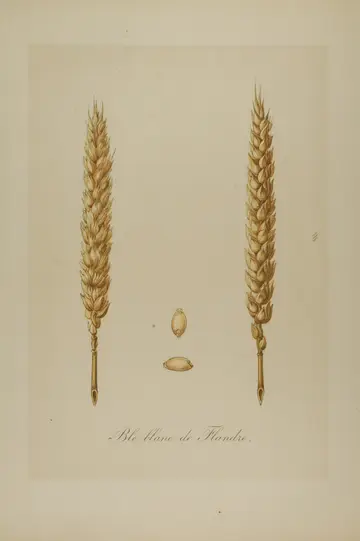
Description
Form
herbaceous, annual
Height: 50–100 cm
Flower colour
Green
Flowering
April–June
Habitat
Leaves
Strap-shaped leaves sheathing the stem; at the base of each leaf two prominent "ears" clasp the stem.
Flowers
Spikelets in clusters of three set in a herringbone pattern; each spikelet has a long, thin awn up to 16 cm. In six-row barley all three spikelets set grain, in two-row barley only the central one.
Fruit and seeds
A one-seeded grain enclosed in husks.
Classification
- KingdomPlantae
- PhylumTracheophyta
- ClassLiliopsida
- OrderPoales
- FamilyPoaceae
- GenusHordeum
- SpeciesHordeum vulgare
Native range
According to POWO it is native to Türkiye, Cyprus, Greece and the Aegean islands, the Levant, Egypt and Libya, the Arabian Peninsula, Iran, Iraq, the Caucasus, Central Asia, Afghanistan, Pakistan and east to Tibet. This range includes wild barley (subsp. spontaneum).
Growing conditions
Light
Full sun.
Water
Little; fairly tolerant of drought and salty soil.
Soil
Free-draining soil.
Temperature
Likes cool weather; less winter-hardy than wheat or rye.
Culture and history
An old word
According to Turkish Wikipedia, the Turkish word "arpa" is first recorded in the 9th-century Karabalgasun inscription.
Ears that stay whole
Wild barley ears shatter when ripe. During domestication people kept plants whose ears stayed intact, which made harvesting much easier.
Look-alikes
- Bread wheat: Its ears are awnless or short-awned and the spikelets are not in clusters of three. Compare side by side →
- Rye: Taller, with a slender, nodding ear and thinner, longer grains. Compare side by side →
Questions
What is barley grown for?
About 70% of the world's barley is used as animal feed; most of the rest goes to malt and food.
What are six-row and two-row barley?
In six-row barley all three spikelets in each cluster set grain; in two-row barley only the central one does.
Barley: when does it flower?
In spring and summer: April–June. Months are for temperate northern-hemisphere climates and shift with altitude and weather.
Barley: what is its scientific name?
Hordeum vulgare L., in the genus Hordeum and the family Poaceae.
Sources
- Wikipedia: Barley
- World Flora Online
- Plants of the World Online (Kew) · native range (WCVP)
- GBIF · classification
- Wikidata
Checked: 2026-11-17. Spotted a mistake? Tell us.