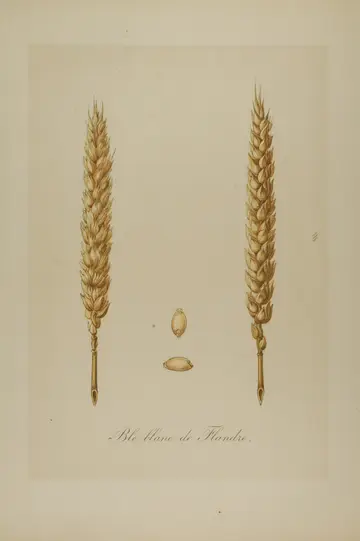
Description
Form
herbaceous, annual or biennial
Height: 1–2 m
Flower colour
Green
Flowering
May–June
Leaves
Long, pointed, blue-green leaves.
Flowers
A slender, slightly nodding ear 7–15 cm long at the top of the stem; the spikelets alternate left and right, each holding two flowers.
Fruit and seeds
Thin, long grains with narrow husks and short awns.
Classification
- KingdomPlantae
- PhylumTracheophyta
- ClassLiliopsida
- OrderPoales
- FamilyPoaceae
- GenusSecale
- SpeciesSecale cereale
Native range
POWO gives Türkiye as its only native area. According to Wikipedia rye's wild relatives grow in the Levant, central and eastern Türkiye and nearby; today it is grown mostly from eastern and northern Europe into Russia.
Growing conditions
Light
Full sun.
Water
Little.
Soil
Gives a good crop even on sandy, loose, poor soils.
Temperature
The most cold-hardy cereal; sown in autumn and cut in early summer.
Culture and history
The mimic weed
According to Wikipedia rye first reached Europe as a weed mixed into wheat fields. Its seeds looked so like wheat that they could not be sorted out, and in time it was sown for its own sake: so-called Vavilovian mimicry.
Triticale
Triticale, a hybrid of wheat and rye, combines the qualities of both parents and is grown widely around the world.
Toxicity
Rye's main disease, ergot, replaces some grains with dark, horn-shaped fungal bodies. The fungus (Claviceps purpurea) contains poisonous alkaloids and has caused mass poisonings (ergotism) in history.
In an emergency call your local poison centre; for pets, contact a vet straight away. See also: plants and pets.
Look-alikes
- Barley: Looks similar, but its spikelets are in threes and its awns very long. Compare side by side →
- Bread wheat: Shorter, with a thicker, upright ear. Compare side by side →
Questions
Why is rye grown in cold places?
It is the most cold-hardy cereal and gives a crop even on poor, sandy soils where wheat does badly.
Rye: when does it flower?
In spring and summer: May–June. Months are for temperate northern-hemisphere climates and shift with altitude and weather.
Rye: what is its scientific name?
Secale cereale L., in the genus Secale and the family Poaceae.
Sources
- Wikipedia: Rye
- World Flora Online
- Plants of the World Online (Kew) · native range (WCVP)
- GBIF · classification
- Wikidata
Checked: 2026-11-17. Spotted a mistake? Tell us.