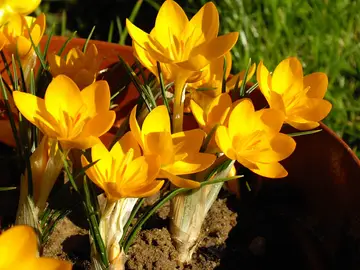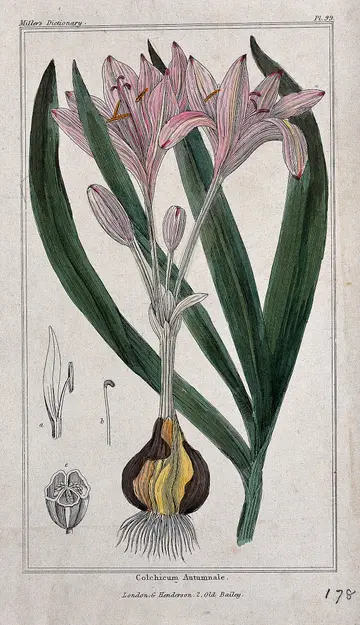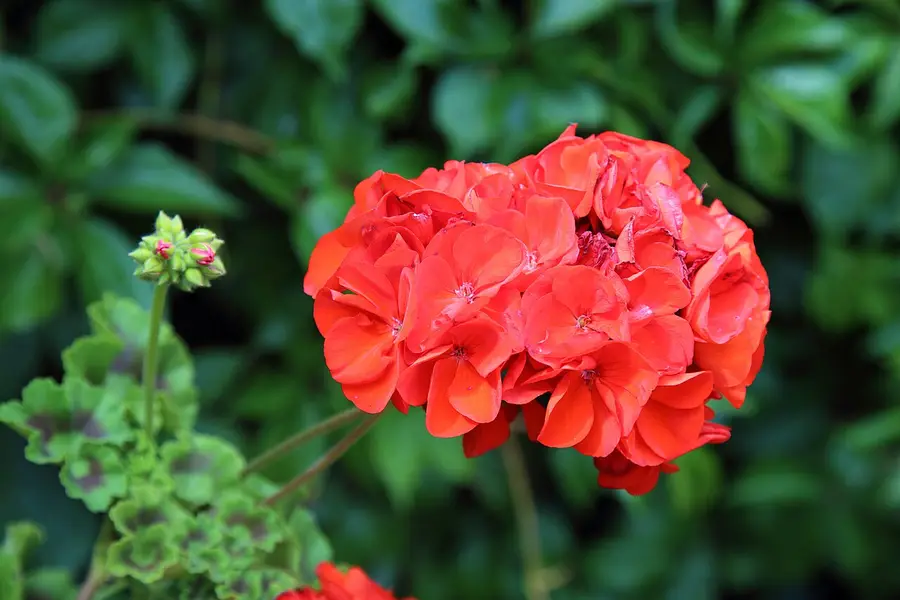
Description
Form
herbaceous, perennial, evergreen
Flower colour
RedPinkWhiteOrange
Flowering
April–October
Habitat
Leaves
Round (about 7 cm across), slightly lobed, hairy leaves, most with a dark horseshoe-shaped band (the "zone" in its name). The whole plant except the flowers smells sharp when crushed.
Flowers
Ball-shaped clusters of red, pink, coral, white or purple flowers on long stalks.
Fruit and seeds
A long, pointed fruit like a crane's bill.
Classification
- KingdomPlantae
- PhylumTracheophyta
- ClassMagnoliopsida
- OrderGeraniales
- FamilyGeraniaceae
- GenusPelargonium
- SpeciesPelargonium × hortorum
Native range
It has no wild range. It arose by crossing two South African species, Pelargonium zonale and Pelargonium inquinans. P. zonale was collected in the Western Cape in 1689 and sent to Europe; P. inquinans is recorded in a London collection in 1713. Cultivars have been grown since the late 18th century.
Care
Light
Full sun or a very bright window.
Water
Low to moderate; water when the soil is dry, it dislikes too much water.
Soil
Free-draining potting compost.
Temperature
Not frost hardy; best overwintered somewhere bright and cool, no warmer than 16 °C.
Picking off faded flowers brings new ones. Very easy to propagate from cuttings, which root in about 3 weeks in good conditions. Older plants become leggy and flower less.
Culture and history
Geranium or Pelargonium?
Linnaeus placed these plants in Geranium; they were split off as a separate genus, Pelargonium, in 1789. In everyday language the name "geranium" stuck. The true Geranium species are called cranesbills.
Toxicity
ASPCA lists the genus Pelargonium as toxic to cats, dogs and horses. The toxins are geraniol and linalool; signs are vomiting, loss of appetite, depression and skin irritation.
In an emergency call your local poison centre; for pets, contact a vet straight away. See also: plants and pets.
Look-alikes
- Rose-scented geranium (Pelargonium graveolens): A species of the same genus with deeply divided, rose-scented leaves and small, pale pink flowers; grown mainly for its scent. Compare side by side →
- Cranesbills (Geranium): The true Geranium species; most are wild and hardy, with five equal petals.
Questions
How do I overwinter geraniums?
They are not frost hardy. Keep them somewhere bright and cool (about 8–12 °C) and water sparingly through the winter.
Are geraniums toxic to cats?
Yes. ASPCA lists Pelargonium as toxic to cats, dogs and horses.
Zonal geranium: when does it flower?
In spring and summer and autumn: April–October. Months are for temperate northern-hemisphere climates and shift with altitude and weather.
Zonal geranium: how do you care for it?
Light: Full sun or a very bright window. Water: Low to moderate; water when the soil is dry, it dislikes too much water. Soil: Free-draining potting compost. Temperature: Not frost hardy; best overwintered somewhere bright and cool, no warmer than 16 °C. Older plants become leggy and flower less.
Zonal geranium: how do you propagate it?
Very easy to propagate from cuttings, which root in about 3 weeks in good conditions.
Zonal geranium: when and how do you prune it?
Picking off faded flowers brings new ones.
Zonal geranium: what is its scientific name?
Pelargonium × hortorum L.H.Bailey, in the genus Pelargonium and the family Geraniaceae.
Sources
- Wikipedia: Pelargonium × hortorum
- World Flora Online
- GBIF · classification
- ASPCA Animal Poison Control: Geranium (Pelargonium)
- Wikipedia: Pelargonium × hortorum
Checked: 2026-11-17. Spotted a mistake? Tell us.