Description
Form
succulent, perennial, evergreen
Height: 10–15 cm
Flower colour
White
Flowering
No reliable data in the sources.
Habitat
Leaves
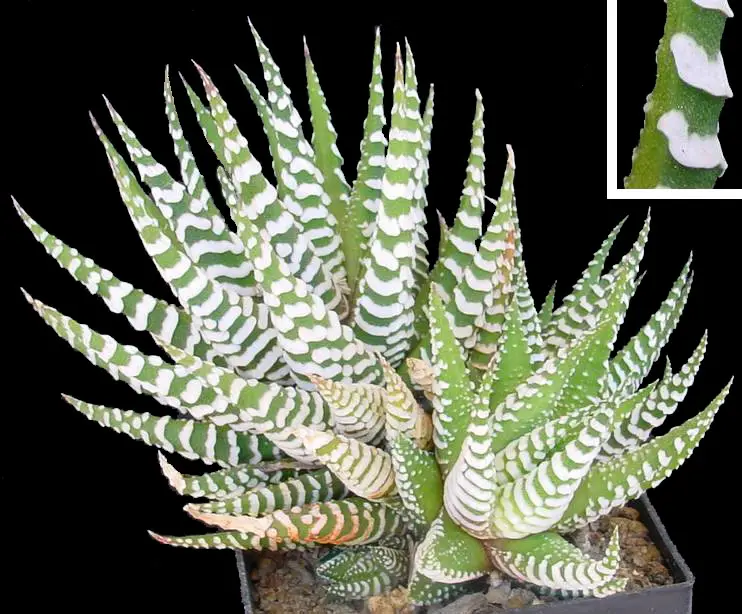
Thick, triangular-sectioned, pointed, dark green leaves; white tubercles on the outer faces form crosswise bands.
Flowers
Small, whitish, tubular flowers on a long, thin stalk.
Classification
- KingdomPlantae
- PhylumTracheophyta
- ClassLiliopsida
- OrderAsparagales
- FamilyAsphodelaceae
- GenusHaworthiopsis
- SpeciesHaworthiopsis attenuata
Native range
According to POWO it is native to the Cape region of South Africa, growing in scrub and in the shade of rocks.
Care
Light
Bright indirect light; the leaves redden in midday sun.
Water
Little. Water when the soil is completely dry; in winter once a month or not at all.
Soil
Cactus and succulent compost, or a very free-draining mix with added grit or perlite.
Temperature
10–27 °C.
Propagate from the offsets at the base.
Culture and history
The name
Long placed in Haworthia, it was moved to the genus Haworthiopsis in 2013. It is still usually sold as "Haworthia".
Toxicity
ASPCA lists the zebra haworthia as non-toxic to cats, dogs and horses (the entry is for Haworthia fasciata, a very close relative).
In an emergency call your local poison centre; for pets, contact a vet straight away. See also: plants and pets.
Look-alikes
- Haworthiopsis fasciata: A very similar relative; the white bands are only on the outer face of the leaf and the inner face is smooth.
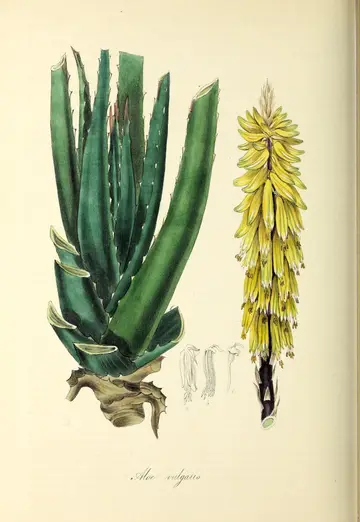
- Aloe vera: Same family, much larger, with grey-green leaves. Compare side by side →
Questions
Is the zebra plant a cactus?
No. It is a succulent in the same family as aloe (Asphodelaceae) and has no spines.
Zebra plant: how do you care for it?
Light: Bright indirect light; the leaves redden in midday sun. Water: Little. Water when the soil is completely dry; in winter once a month or not at all. Soil: Cactus and succulent compost, or a very free-draining mix with added grit or perlite. Temperature: 10–27 °C.
Zebra plant: how do you propagate it?
Propagate from the offsets at the base.
Zebra plant: is it toxic to cats and dogs?
Non-toxic to cats and dogs. Non-toxic to pets (ASPCA).
Zebra plant: what is its scientific name?
Haworthiopsis attenuata (Haw.) G.D.Rowley, in the genus Haworthiopsis and the family Asphodelaceae.
Sources
- Wikipedia: Haworthiopsis attenuata
- World Flora Online
- Plants of the World Online (Kew) · native range (WCVP)
- GBIF · classification
- Wikidata
- ASPCA Animal Poison Control: Zebra Haworthia (Haworthia fasciata)
Checked: 2026-11-16. Spotted a mistake? Tell us.