Description
Form
subshrub, perennial, evergreen
Height: Up to 1.5 m
Flower colour
PinkWhite
Flowering
March–June
Habitat
Leaves
Alternate, long-stalked, heart-shaped, deeply palmately divided leaves, velvety and soft thanks to glandular hairs. The wild form smells of mint; some cultivars smell of roses.
Flowers
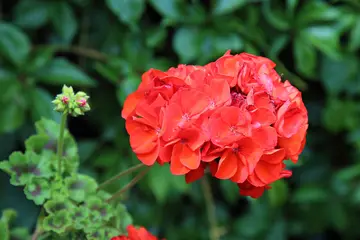
Small clusters of flowers from pale pink to almost white, the upper petals with dark veins.
Fruit and seeds
A long, pointed fruit like a stork's or crane's bill.
Classification
- KingdomPlantae
- PhylumTracheophyta
- ClassMagnoliopsida
- OrderGeraniales
- FamilyGeraniaceae
- GenusPelargonium
- SpeciesPelargonium graveolens
Native range
According to POWO it is native to the Cape and Northern Provinces of South Africa and to Zimbabwe; Wikipedia also lists Mozambique.
Care
Light
Full sun or a very bright window.
Water
Low to moderate; water when the soil is dry.
Soil
Free-draining potting compost.
Temperature
Not frost hardy.
Easily propagated from cuttings; pinching the tips makes it bushier.
Culture and history
The name
Pelargonium comes from the Greek pelargos, stork, because the fruits look like a stork's bill. The species name graveolens means "strong-smelling".
Toxicity
ASPCA lists the genus Pelargonium (geraniums and scented geraniums) as toxic to cats, dogs and horses. The toxins are geraniol and linalool; signs are vomiting, loss of appetite, depression and skin irritation.
In an emergency call your local poison centre; for pets, contact a vet straight away. See also: plants and pets.
Look-alikes
- Zonal geranium: Same genus; its leaves are round and only slightly lobed, and its flowers large, in ball-shaped clusters. Compare side by side →
Questions
Is rose geranium toxic to cats?
Yes. ASPCA lists Pelargonium as toxic to cats, dogs and horses.
Rose geranium: when does it flower?
In spring and summer: March–June. Months are for temperate northern-hemisphere climates and shift with altitude and weather.
Rose geranium: how do you care for it?
Light: Full sun or a very bright window. Water: Low to moderate; water when the soil is dry. Soil: Free-draining potting compost. Temperature: Not frost hardy.
Rose geranium: how do you propagate it?
Easily propagated from cuttings; pinching the tips makes it bushier.
Rose geranium: what is its scientific name?
Pelargonium graveolens L'Hér., in the genus Pelargonium and the family Geraniaceae.
Sources
- Wikipedia: Pelargonium graveolens
- ASPCA Animal Poison Control: Geranium (Pelargonium)
- World Flora Online
- Plants of the World Online (Kew) · native range (WCVP)
- GBIF · classification
- Wikidata
Checked: 2026-11-17. Spotted a mistake? Tell us.