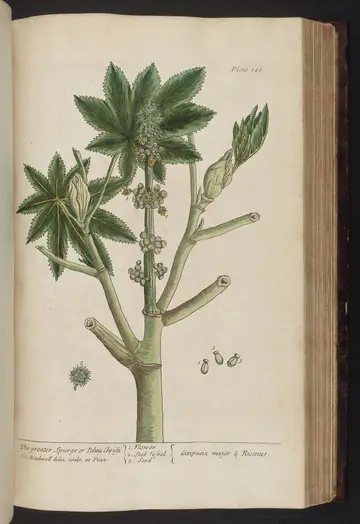
Description
Form
shrubby succulent, perennial, evergreen
Height: 1–2 m in a pot
Flowering
No reliable data in the sources.
Habitat
Leaves
The stems are three-angled (sometimes four), with short paired spines and small spoon-shaped leaves along the edges. There are red-leaved cultivars ("Rubra").
Flowers
It rarely flowers in a pot.
Classification
- KingdomPlantae
- PhylumTracheophyta
- ClassMagnoliopsida
- OrderMalpighiales
- FamilyEuphorbiaceae
- GenusEuphorbia
- SpeciesEuphorbia trigona
Native range
According to POWO it is native to Central Africa (Gabon, Congo, the Democratic Republic of the Congo, Angola) and Malawi. Its wild populations are poorly known; it has spread around the world mainly as a cultivated plant.
Care
Light
Bright light.
Water
When the soil is dry; very little in winter.
Soil
Cactus and succulent compost, or a very free-draining mix with added grit or perlite.
Temperature
Not frost hardy.
Like all spurges (Euphorbia), it bleeds a white milky sap that irritates skin and eyes; wear gloves when pruning and keep the sap away from the eyes and mouth.
Toxicity
The white milky sap irritates the skin and can cause severe burning and inflammation if it gets into the eyes; eating the plant irritates the mouth and stomach.
In an emergency call your local poison centre; for pets, contact a vet straight away. See also: plants and pets.
Look-alikes
- Columnar cacti (Cactaceae): They look similar, but cactus spines grow from hairy cushions called areoles, cacti have no leaves, and they do not bleed milky sap.
Questions
Is the African milk tree a cactus?
No. Although it looks like one, it is a spurge (Euphorbiaceae); it bleeds white milky sap when broken and carries small leaves on its stems.
African milk tree: how do you care for it?
Light: Bright light. Water: When the soil is dry; very little in winter. Soil: Cactus and succulent compost, or a very free-draining mix with added grit or perlite. Temperature: Not frost hardy.
African milk tree: when and how do you prune it?
Like all spurges (Euphorbia), it bleeds a white milky sap that irritates skin and eyes; wear gloves when pruning and keep the sap away from the eyes and mouth.
African milk tree: what is its scientific name?
Euphorbia trigona Mill., in the genus Euphorbia and the family Euphorbiaceae.
Sources
- Wikipedia: Euphorbia trigona
- World Flora Online
- Plants of the World Online (Kew) · native range (WCVP)
- GBIF · classification
- Wikidata
Checked: 2026-11-16. Spotted a mistake? Tell us.