Description
Form
epiphytic herb, perennial, evergreen
Height: 30–60 cm (with flower stem)
Flower colour
WhitePinkPurpleYellow
Flowering
No reliable data in the sources.
Habitat
Leaves
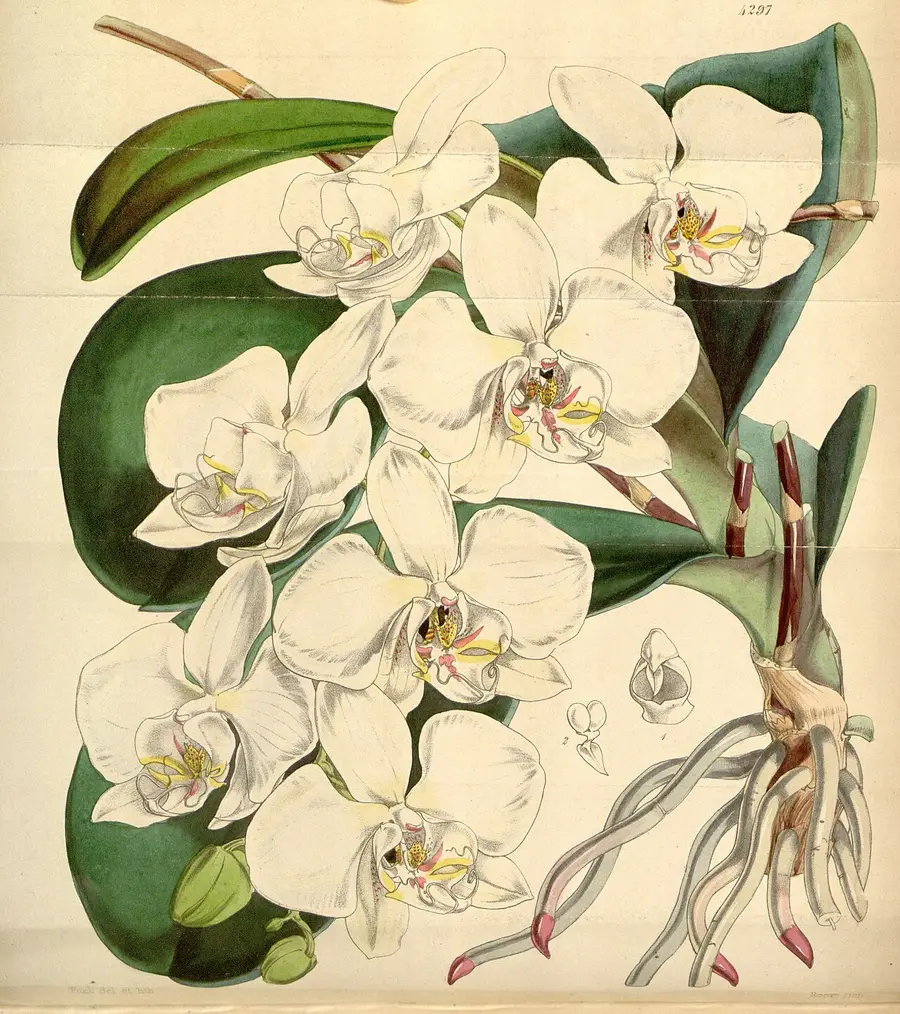
A few broad, fleshy leaves; silvery aerial roots grow out of the pot.
Flowers
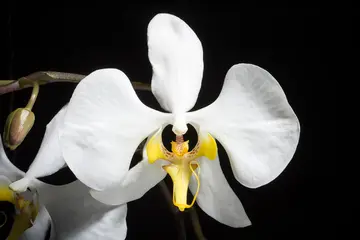
Flat flowers with broad petals on an arching stem; wild plants are white, cultivars come in many colours.
Fruit and seeds
A capsule with dust-like seeds.
Classification
- KingdomPlantae
- PhylumTracheophyta
- ClassLiliopsida
- OrderAsparagales
- FamilyOrchidaceae
- GenusPhalaenopsis
- SpeciesPhalaenopsis amabilis
Native range
According to POWO it is native to Sumatra, Java, Borneo, Sulawesi, the Maluku and Lesser Sunda Islands, the Philippines, New Guinea, the Bismarck Archipelago and Queensland, where it grows on trees in humid forests.
Care
Light
Bright, indirect light; an east window is ideal.
Water
When the bark mix is almost dry and the roots turn silvery; never leave water in the crown.
Soil
Coarse bark orchid mix, never ordinary soil.
Temperature
18–28 °C; a night-time drop of 5–7 °C for a few weeks in autumn helps it flower again.
Green roots and a transparent pot make it easy to see when to water.
Toxicity
ASPCA lists the genus Phalaenopsis as non-toxic to cats, dogs and horses.
In an emergency call your local poison centre; for pets, contact a vet straight away. See also: plants and pets.
Look-alikes
- Vanilla orchid: An orchid that climbs like a vine; its cured pods are the spice vanilla. Compare side by side →
Questions
Are orchids safe for cats?
Moth orchids are. ASPCA lists Phalaenopsis as non-toxic to cats, dogs and horses.
Moth orchid: how do you care for it?
Light: Bright, indirect light; an east window is ideal. Water: When the bark mix is almost dry and the roots turn silvery; never leave water in the crown. Soil: Coarse bark orchid mix, never ordinary soil. Temperature: 18–28 °C; a night-time drop of 5–7 °C for a few weeks in autumn helps it flower again. Green roots and a transparent pot make it easy to see when to water.
Moth orchid: is it toxic to cats and dogs?
Non-toxic to cats and dogs. Non-toxic.
Moth orchid: what is its scientific name?
Phalaenopsis amabilis (L.) Blume, in the genus Phalaenopsis and the family Orchidaceae.
Sources
- ASPCA Animal Poison Control: Phalaenopsis orchid
- Wikipedia: Phalaenopsis amabilis
- World Flora Online
- Plants of the World Online (Kew) · native range (WCVP)
- GBIF · classification
- Wikidata
Checked: 2026-11-16. Spotted a mistake? Tell us.