Description
Form
herbaceous, perennial, evergreen
Height: 20–40 cm; arching stems over 60 cm
Flower colour
White
Flowering
No reliable data in the sources.
Habitat
Leaves
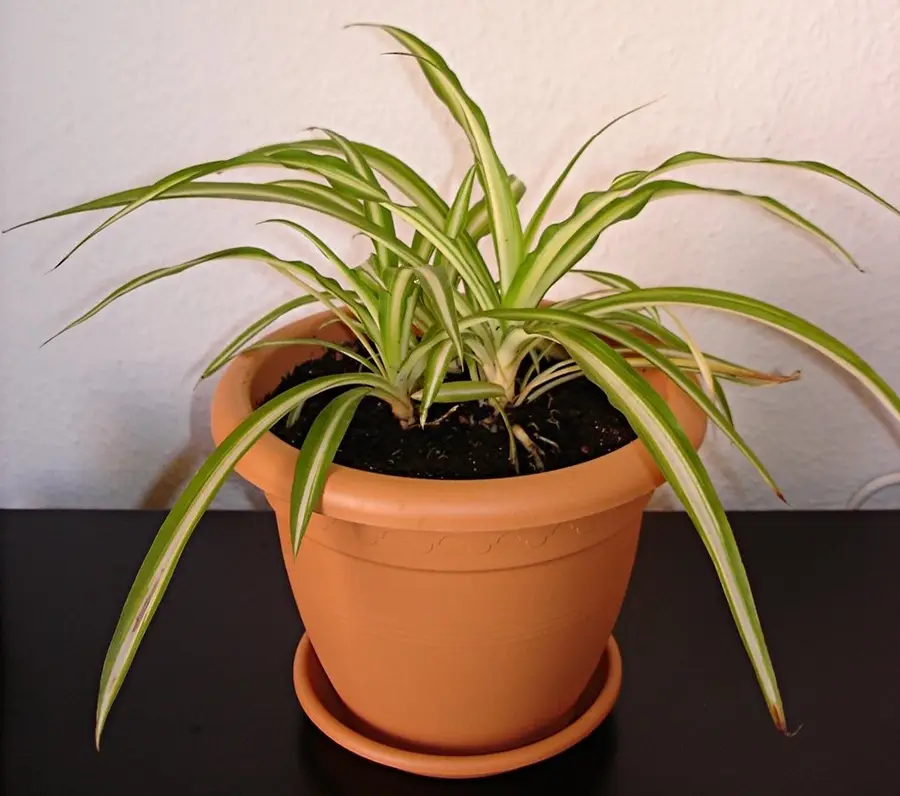
Arching, strap-shaped leaves 20–45 cm long. The commonest cultivars have white or cream lengthwise stripes. The roots are fleshy and store water.
Flowers
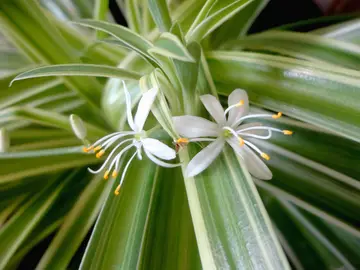
Small, white, six-parted flowers on long, arching stems. Rooted plantlets develop at the ends of the same stems.
Fruit and seeds
A small, three-angled capsule.
Classification
- KingdomPlantae
- PhylumTracheophyta
- ClassLiliopsida
- OrderAsparagales
- FamilyAsparagaceae
- GenusChlorophytum
- SpeciesChlorophytum comosum
Native range
According to POWO it is native across a wide area from West Africa (Sierra Leone, Ivory Coast, Nigeria, Cameroon) to East Africa (Ethiopia, Kenya, Tanzania, Uganda) and South Africa, growing on the forest floor and in shady places.
Care
Light
Bright indirect light is best; it tolerates less. Hot direct sun scorches the leaf tips.
Water
Water when the top 2–3 cm of soil is dry; do not leave water in the saucer.
Soil
Any free-draining potting compost.
Temperature
13–27 °C.
Plantlets root easily when cut off and set in soil or water. Brown leaf tips are mostly caused by dry air or fluoride and salts in tap water.
Culture and history
Does it clean the air?
In NASA's Clean Air Study it reduced formaldehyde in the laboratory. But a typical home would need a great many plants for any measurable effect, and later studies showed these results do not carry over to real rooms.
Toxicity
ASPCA lists the spider plant as non-toxic to cats and dogs. Cats love to chew the leaves; cats that eat a lot may get a mild stomach upset.
In an emergency call your local poison centre; for pets, contact a vet straight away. See also: plants and pets.
Look-alikes
- Lucky bamboo (Dracaena sanderiana): Both are sometimes called "ribbon plant", which causes confusion. Lucky bamboo forms jointed, bamboo-like stems.
Questions
Are spider plants toxic to cats?
No. ASPCA lists the spider plant as non-toxic to cats and dogs.
Why do spider plant tips go brown?
Mostly because of dry air, irregular watering or salt and fluoride build-up from water. Watering with rain water or water left to stand helps.
Spider plant: how do you care for it?
Light: Bright indirect light is best; it tolerates less. Hot direct sun scorches the leaf tips. Water: Water when the top 2–3 cm of soil is dry; do not leave water in the saucer. Soil: Any free-draining potting compost. Temperature: 13–27 °C. Brown leaf tips are mostly caused by dry air or fluoride and salts in tap water.
Spider plant: how do you propagate it?
Plantlets root easily when cut off and set in soil or water.
Spider plant: what is its scientific name?
Chlorophytum comosum (Thunb.) Jacques, in the genus Chlorophytum and the family Asparagaceae.
Sources
- Wikipedia: Chlorophytum comosum
- World Flora Online
- Plants of the World Online (Kew) · native range (WCVP)
- GBIF · classification
- Wikidata
- ASPCA Animal Poison Control: Spider Plant (Chlorophytum comosum)
Checked: 2026-11-16. Spotted a mistake? Tell us.