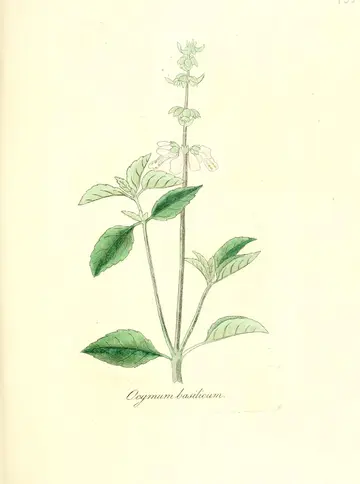
Description
Form
herbaceous, annual
Height: 50–150 cm
Flower colour
WhitePink
Flowering
July–August
Habitat
Leaves
Opposite or alternate leaves, the lower ones lobed and the upper ones lance-shaped; slightly hairy.
Flowers
Tubular white, pink or purplish flowers 2–3 cm long in the leaf axils.
Fruit and seeds
Four-angled, elongated, hairy capsules that split from the top when ripe and scatter small, flat seeds.
Classification
- KingdomPlantae
- PhylumTracheophyta
- ClassMagnoliopsida
- OrderLamiales
- FamilyPedaliaceae
- GenusSesamum
- SpeciesSesamum indicum
Native range
According to POWO it is native to India, Bangladesh, Assam and the western Himalaya. It is known to have been grown on the Indian subcontinent for at least 4,000 years.
Culture and history
Open sesame
The magic words in "Ali Baba and the Forty Thieves" from the Thousand and One Nights are often read as a nod to sesame capsules bursting open when ripe. This shattering also matters in farming, because it loses seed at harvest.
Questions
Why do sesame capsules open?
As the ripe capsules dry they split along their seams and the seeds fall out. Sesame is therefore harvested before the capsules open.
Sesame: when does it flower?
In summer: July–August. Months are for temperate northern-hemisphere climates and shift with altitude and weather.
Sesame: what is its scientific name?
Sesamum indicum L., in the genus Sesamum and the family Pedaliaceae.
Sources
- Wikipedia: Sesame
- World Flora Online
- Plants of the World Online (Kew) · native range (WCVP)
- GBIF · classification
- Wikidata
Checked: 2026-11-17. Spotted a mistake? Tell us.