Description
Form
herbaceous, annual
Height: 0.4–1 m
Flower colour
White
Flowering
No reliable data in the sources.
Leaves
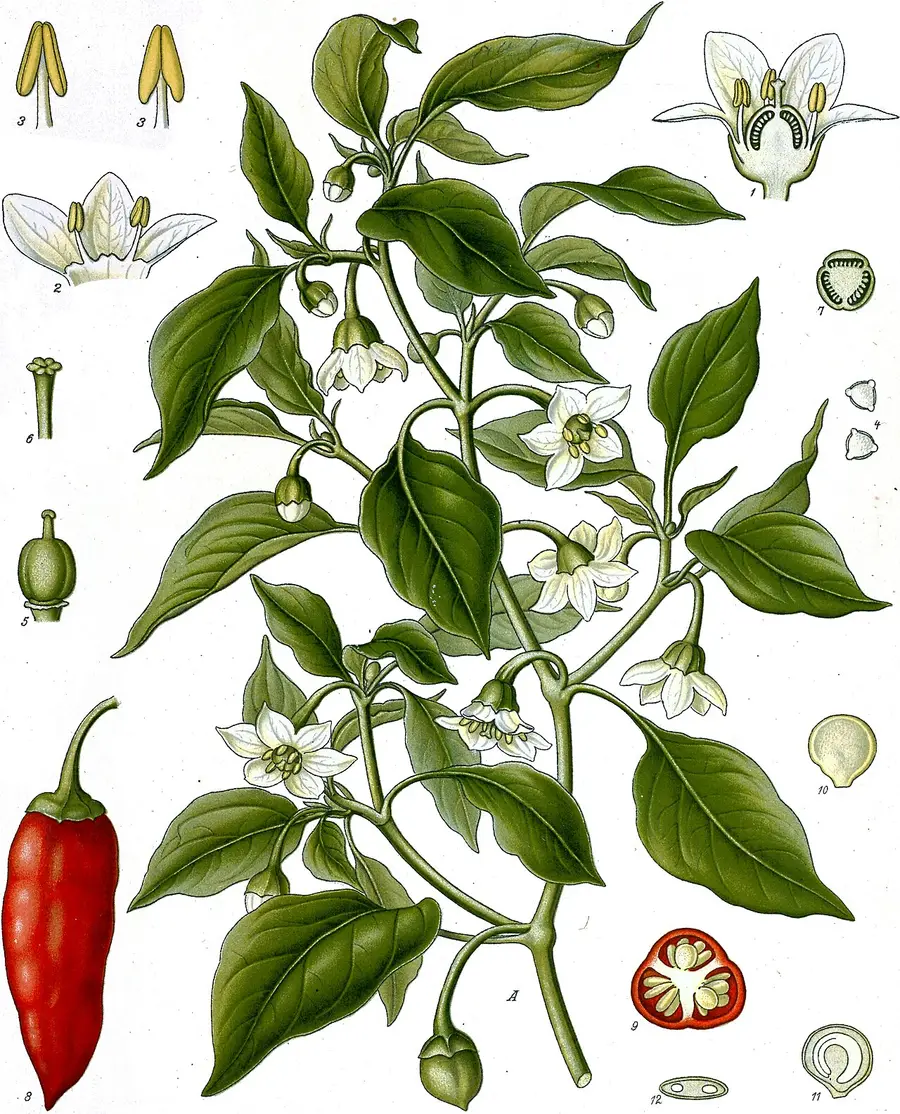
Simple, oval or lance-shaped, smooth-edged, glossy leaves.
Flowers
Small, white or greenish-white five-parted flowers, single in the leaf axils.
Fruit and seeds
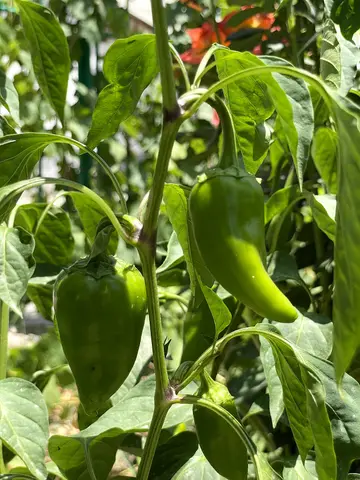
A hollow berry that ripens from green to red, yellow or orange. Capsaicin, the source of heat, is concentrated in the pale inner membranes that hold the seeds.
Classification
- KingdomPlantae
- PhylumTracheophyta
- ClassMagnoliopsida
- OrderSolanales
- FamilySolanaceae
- GenusCapsicum
- SpeciesCapsicum annuum
Native range
According to POWO it is native from the southern United States (Texas, Arizona, Florida) through Mexico, Central America and the Caribbean to Colombia, Venezuela, Peru and northern Brazil. It was domesticated in Mexico.
IUCN Red List status: Least concern (LC).
Growing conditions
Light
Full sun.
Water
Regular, even watering.
Soil
Free-draining, fertile soil.
Temperature
Loves heat; not frost hardy. Planted out later than tomatoes.
Culture and history
Why "pepper"?
Columbus likened this pungent fruit of the Americas to Asian black pepper, so the name stuck to two unrelated plants: black pepper (Piper nigrum) belongs to an entirely different family.
Look-alikes
- Jerusalem cherry (Solanum pseudocapsicum): An ornamental pot plant with round orange-red fruit. It is not a pepper, and ASPCA lists it as toxic to cats, dogs and horses.
Questions
Are bell peppers and chilli peppers the same species?
Mostly, yes: bell peppers, long green peppers and many hot varieties are all Capsicum annuum.
Where does a pepper's heat come from?
From capsaicin, concentrated in the pale inner membranes that hold the seeds.
Pepper: how do you grow it?
Light: Full sun. Water: Regular, even watering. Soil: Free-draining, fertile soil. Temperature: Loves heat; not frost hardy. Planted out later than tomatoes.
Pepper: what is its scientific name?
Capsicum annuum L., in the genus Capsicum and the family Solanaceae.
Sources
- Wikipedia: Capsicum annuum
- World Flora Online
- Plants of the World Online (Kew) · native range (WCVP)
- GBIF · classification
Checked: 2026-11-16. Spotted a mistake? Tell us.