Description
Form
tree, perennial, deciduous
Height: 4–8 m
Flower colour
Pink
Flowering
March–April
Habitat
Leaves
Long, lance-shaped, finely toothed, glossy green leaves.
Flowers
Short-stalked pink flowers with five petals, usually opening before the leaves, singly or in pairs along the branches.
Fruit and seeds
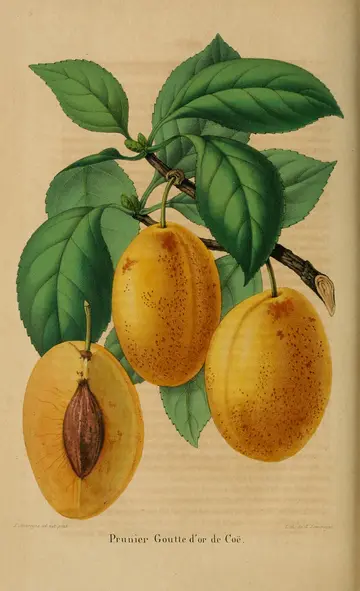
A juicy, fleshy drupe with a hard, deeply furrowed stone inside. The skin is velvety; in nectarines it is smooth and shiny.
Classification
- KingdomPlantae
- PhylumTracheophyta
- ClassMagnoliopsida
- OrderRosales
- FamilyRosaceae
- GenusPrunus
- SpeciesPrunus persica
Native range
According to POWO it is native only to north-central China. It was domesticated in China thousands of years ago and reached the Mediterranean and Europe via Iran; today it is grown in almost every temperate region of the world.
Growing conditions
Light
Full sun.
Water
Regular watering.
Soil
Free-draining sandy loam.
Temperature
Needs winter cold, but flowers early and is sensitive to spring frosts.
Needs treatment against peach leaf curl at the end of winter.
Culture and history
Nectarines
The nectarine is not a separate species: it is a peach whose skin is smooth because of a difference in a single gene. A peach branch and a nectarine branch can even appear on the same tree.
Immortality in China
In Chinese mythology the peach is a symbol of long life and immortality.
Toxicity
ASPCA lists the peach (Prunus persica) as toxic to cats, dogs and horses: the stems, leaves and stones contain cyanogenic glycosides, and wilting leaves are especially dangerous. Signs are brick-red mucous membranes, dilated pupils, difficulty breathing and shock. The flesh of the fruit is not considered dangerous; the stones should not be swallowed.
In an emergency call your local poison centre; for pets, contact a vet straight away. See also: plants and pets.
Look-alikes
- Apricot: Same genus; its leaves are round and heart-shaped, its flowers white or pale pink, and its fruit skin less fuzzy. Peach leaves are long and lance-shaped. Compare side by side →
- Almond (Prunus amygdalus): Its flowers and leaves are very like the peach's, but the fruit has thin flesh that dries and splits when ripe; only the kernel is used.
Questions
What is the difference between a peach and a nectarine?
Nectarines are peach cultivars with smooth skin, caused by a difference in a single gene; both are the same species (Prunus persica).
Are peach stones toxic to pets?
Yes. ASPCA lists the stems, leaves and stones of the peach as toxic to cats, dogs and horses; the stone contains cyanogenic glycosides and can also block the gut.
Peach: when does it flower?
In spring: March–April. Months are for temperate northern-hemisphere climates and shift with altitude and weather.
Peach: how do you grow it?
Light: Full sun. Water: Regular watering. Soil: Free-draining sandy loam. Temperature: Needs winter cold, but flowers early and is sensitive to spring frosts. Needs treatment against peach leaf curl at the end of winter.
Peach: what is its scientific name?
Prunus persica (L.) Batsch, in the genus Prunus and the family Rosaceae.
Sources
- Wikipedia: Peach
- ASPCA Animal Poison Control: Peach (Prunus persica)
- World Flora Online
- Plants of the World Online (Kew) · native range (WCVP)
- GBIF · classification
- Wikidata
Checked: 2026-11-17. Spotted a mistake? Tell us.