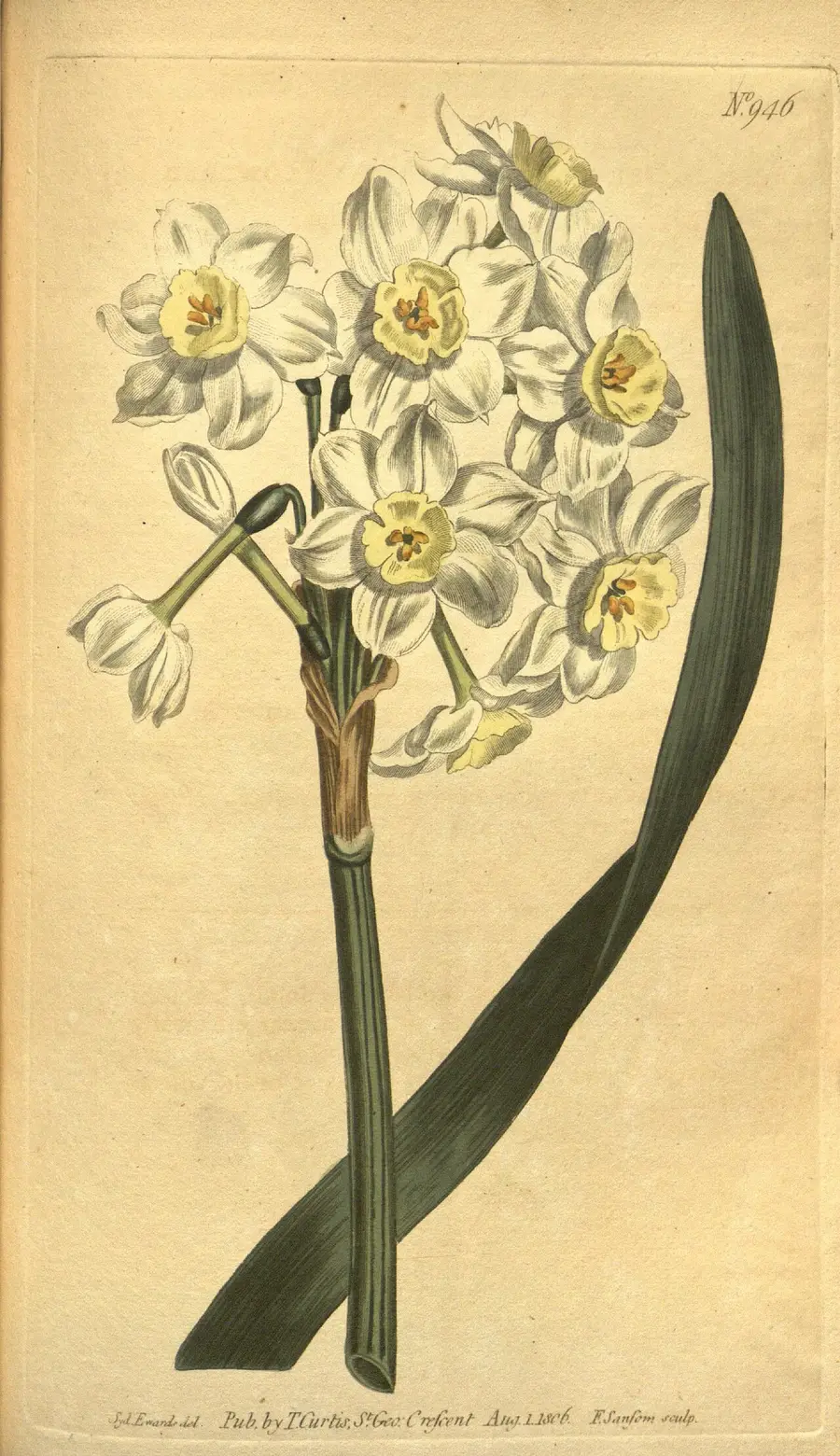
Description
Form
herbaceous, perennial
Height: Up to 80 cm
Flower colour
WhiteYellow
Flowering
December–March
Leaves
Narrow, flat, strap-shaped leaves up to 40 cm long and 1.5 cm wide, rising from the bulb.
Flowers
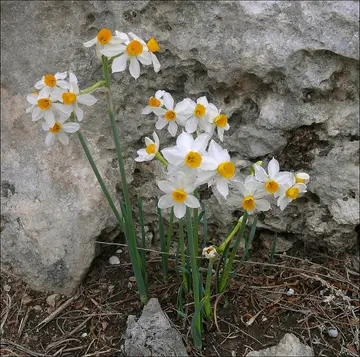
Up to 8 flowers in an umbel on each stalk, with six white tepals and a short yellow cup (corona). Very fragrant; one compound in the scent is barely detectable to people but easily noticed by honeybees.
Fruit and seeds
A three-chambered capsule.
Classification
- KingdomPlantae
- PhylumTracheophyta
- ClassLiliopsida
- OrderAsparagales
- FamilyAmaryllidaceae
- GenusNarcissus
- SpeciesNarcissus tazetta
Native range
According to POWO it is native to most of the Mediterranean Basin (Spain, France, Italy, Greece, Türkiye, North Africa, the Levant), the Canary Islands, and from Iran to Central Asia. POWO also counts populations in China and Japan as native, though they may have been introduced very long ago.
Growing conditions
Light
Sun or partial shade.
Water
Moderate in winter and spring; dry in summer.
Soil
Free-draining soil.
Temperature
Likes a Mediterranean climate; less frost hardy than other daffodils.
Plant the bulbs in autumn.
Culture and history
In Ottoman poetry
In Ottoman divan poetry the narcissus stands for the beloved's languid, half-closed eye.
Perfume
The narcissus is grown commercially for its essential oil, mainly in southern France.
Toxicity
All narcissi contain lycorine and other alkaloids, most of all in the bulb. ASPCA lists vomiting, drooling and diarrhoea as signs; large amounts can cause convulsions, low blood pressure, tremors and heart rhythm problems. People have been poisoned after mistaking narcissus bulbs for onions.
In an emergency call your local poison centre; for pets, contact a vet straight away. See also: plants and pets.
Look-alikes
- Onion: Narcissus bulbs and leaves can be mistaken for onions and cause poisoning. A cut onion smells of onion; a narcissus does not. Compare side by side →
- Jonquil (Narcissus jonquilla) and wild daffodil (N. pseudonarcissus): Other narcissi: the jonquil is all yellow, the wild daffodil has a single flower with a large trumpet.
Questions
Is narcissus poisonous?
Yes. All narcissi, especially the bulbs, contain poisonous alkaloids such as lycorine. The bulbs must not be confused with onions; they are toxic to cats, dogs and horses too.
When does it flower?
In winter, from December to March on the Aegean and Mediterranean coasts.
Bunch-flowered narcissus: how do you grow it?
Light: Sun or partial shade. Water: Moderate in winter and spring; dry in summer. Soil: Free-draining soil. Temperature: Likes a Mediterranean climate; less frost hardy than other daffodils. Plant the bulbs in autumn.
Bunch-flowered narcissus: what is its scientific name?
Narcissus tazetta L., in the genus Narcissus and the family Amaryllidaceae.
Sources
- Wikipedia: Narcissus tazetta
- World Flora Online
- Plants of the World Online (Kew) · native range (WCVP)
- GBIF · classification
- Wikidata
- ASPCA Animal Poison Control: Narcissus
Checked: 2026-11-16. Spotted a mistake? Tell us.