Description
Form
herbaceous succulent, perennial, evergreen
Height: 0.5–1 m
Flower colour
Pink
Flowering
December–February
Habitat
Leaves
Long, lance-shaped, fleshy, bluish-green leaves spotted purple underneath; tiny plantlets form between the marginal teeth.
Flowers
Nodding, bell-shaped, pinkish-grey flowers at the top of a tall stalk. The plant usually dies after flowering.
Fruit and seeds
Small, dry capsules.
Classification
- KingdomPlantae
- PhylumTracheophyta
- ClassMagnoliopsida
- OrderSaxifragales
- FamilyCrassulaceae
- GenusKalanchoe
- SpeciesKalanchoe daigremontiana
Native range
According to POWO it is native only to Madagascar, where its wild populations are limited to a small area in the south-west. It has escaped from gardens and naturalised in many tropical and subtropical regions.
IUCN Red List status: Endangered (EN).
Care
Light
Bright light.
Water
When the soil is dry.
Soil
Cactus and succulent compost, or a very free-draining mix with added grit or perlite.
Temperature
Not frost hardy.
Fallen plantlets root easily around the pot, so keep them under control.
Culture and history
Both invasive and endangered
Because it lives in a small area of its native Madagascar, the IUCN assesses it as Endangered, while in places such as Australia, Florida and South Africa it is an invasive plant that spreads quickly by its plantlets.
Toxicity
ASPCA lists Kalanchoe species as toxic to cats and dogs; the toxins are bufadienolides, which affect the heart. Signs are vomiting, diarrhoea and, rarely, abnormal heart rhythm.
In an emergency call your local poison centre; for pets, contact a vet straight away. See also: plants and pets.
Look-alikes
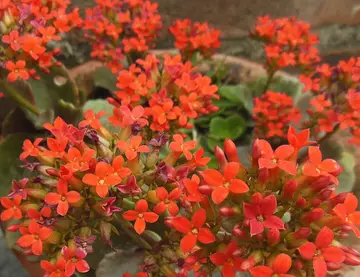
- Flaming Katy: Same genus, but with round, glossy leaves, no plantlets, and upright clusters of colourful flowers. Compare side by side →
Questions
Why does mother of thousands spread so much?
Hundreds of tiny plantlets with their own roots form along the leaf edges and take root as soon as they drop.
Is kalanchoe toxic to cats?
Yes. ASPCA lists Kalanchoe species as toxic to cats and dogs.
Mother of thousands: when does it flower?
In winter: December–February. Months are for temperate northern-hemisphere climates and shift with altitude and weather.
Mother of thousands: how do you care for it?
Light: Bright light. Water: When the soil is dry. Soil: Cactus and succulent compost, or a very free-draining mix with added grit or perlite. Temperature: Not frost hardy.
Mother of thousands: how do you propagate it?
Fallen plantlets root easily around the pot, so keep them under control.
Mother of thousands: what is its scientific name?
Kalanchoe daigremontiana Raym.-Hamet & H.Perrier, in the genus Kalanchoe and the family Crassulaceae.
Sources
- Wikipedia: Kalanchoe daigremontiana
- World Flora Online
- Plants of the World Online (Kew) · native range (WCVP)
- GBIF · classification
- Wikidata
- ASPCA Animal Poison Control: Kalanchoe (Kalanchoe spp.)
Checked: 2026-11-16. Spotted a mistake? Tell us.