Description
Form
herbaceous, perennial
Height: Usually 1.2 m; up to 2 m
Flower colour
White
Flowering
May–June
Habitat
Leaves
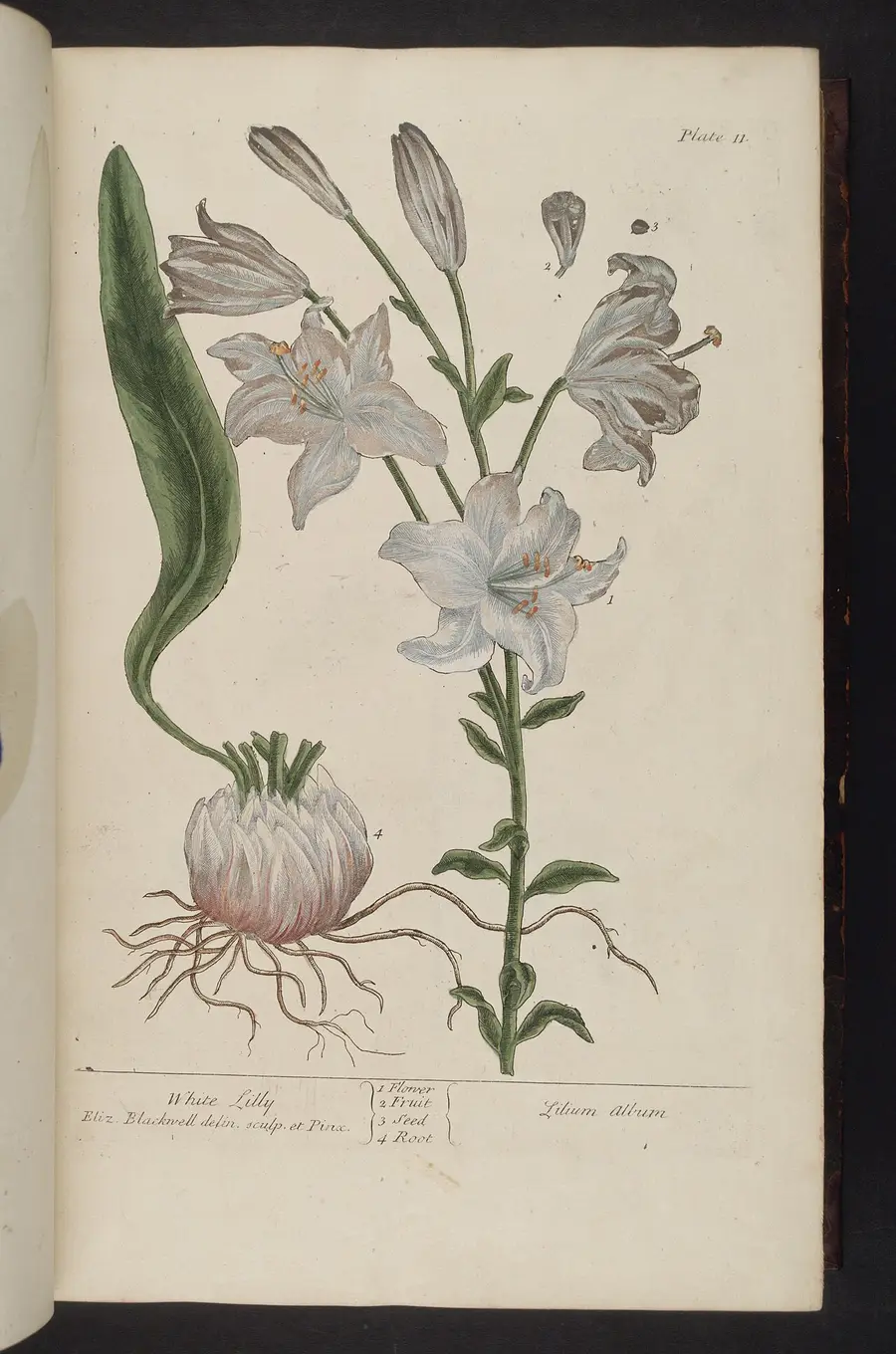
Unlike other lilies it forms a rosette of leaves at ground level in winter, which dies back the next summer. The flowering stem carries smaller, lance-shaped leaves.
Flowers
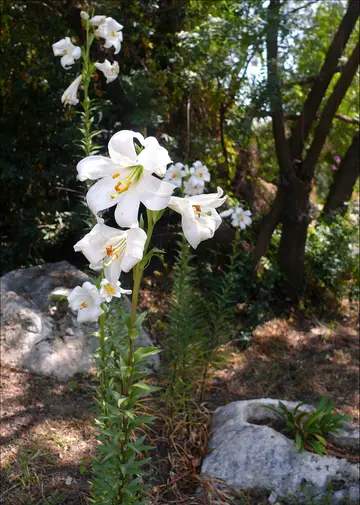
Several flowers at the top of a stem that rises in late spring: pure white, trumpet-shaped with recurved tepals and a yellowish throat, yellow anthers and a strong scent.
Fruit and seeds
A three-chambered capsule; rarely sets seed in cultivation.
Classification
- KingdomPlantae
- PhylumTracheophyta
- ClassLiliopsida
- OrderLiliales
- FamilyLiliaceae
- GenusLilium
- SpeciesLilium candidum
Native range
According to POWO it is native to Türkiye, Greece, the Aegean islands, the western Balkans, Lebanon–Syria and Palestine; POWO marks the native population in Thrace as extinct. Because it has been grown in gardens since ancient times, wild populations are scattered.
Growing conditions
Light
Full sun.
Water
Low to moderate; dry during summer dormancy.
Soil
Free-draining, limy soil.
Temperature
Hardy.
Unlike most lilies, the bulbs are planted very shallowly, only 2–3 cm deep, in late summer. Susceptible to viruses and Botrytis.
Culture and history
Symbol of purity
In Catholic and some Orthodox iconography the white lily symbolises purity; in medieval Annunciation paintings Gabriel offers it to Mary. It has been grown for at least 3,000 years; Minoan art such as the "Prince of the Lilies" fresco at Knossos depicts it.
Toxicity
True lilies (genus Lilium) are extremely dangerous to cats. Following ASPCA's Easter lily entry, signs are vomiting, loss of appetite, lethargy and kidney failure, and death can occur. The toxic principle is unknown and cats are the only species known to be affected: a few leaves, pollen or vase water may be enough. Listed as non-toxic to dogs and horses.
In an emergency call your local poison centre; for pets, contact a vet straight away. See also: plants and pets.
Look-alikes
- Peace lily: Not a true lily despite its name; it irritates a cat's mouth but does not cause kidney failure. Compare side by side →
Questions
Are lilies toxic to cats?
Yes, extremely. Every part of true lilies (Lilium), including pollen and vase water, can cause kidney failure in cats. A cat that may have eaten lily should be taken to a vet at once.
Madonna lily: when does it flower?
In spring and summer: May–June. Months are for temperate northern-hemisphere climates and shift with altitude and weather.
Madonna lily: how do you grow it?
Light: Full sun. Water: Low to moderate; dry during summer dormancy. Soil: Free-draining, limy soil. Temperature: Hardy. Unlike most lilies, the bulbs are planted very shallowly, only 2–3 cm deep, in late summer. Susceptible to viruses and Botrytis.
Madonna lily: what is its scientific name?
Lilium candidum L., in the genus Lilium and the family Liliaceae.
Sources
- Wikipedia: Lilium candidum
- World Flora Online
- Plants of the World Online (Kew) · native range (WCVP)
- GBIF · classification
- Wikidata
- ASPCA Animal Poison Control: Easter Lily (Lilium longiflorum)
Checked: 2026-11-16. Spotted a mistake? Tell us.