Description
Form
herbaceous, perennial, evergreen
Height: 15–30 cm
Flower colour
White
Flowering
April–May
Leaves
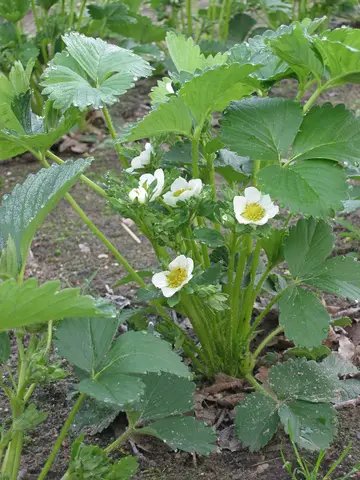
Leaves with three leaflets, each with coarsely toothed edges. The plant makes new plants on runners (stolons) that creep over the soil.
Flowers
White flowers with five petals and many yellow stamens in the centre.
Fruit and seeds
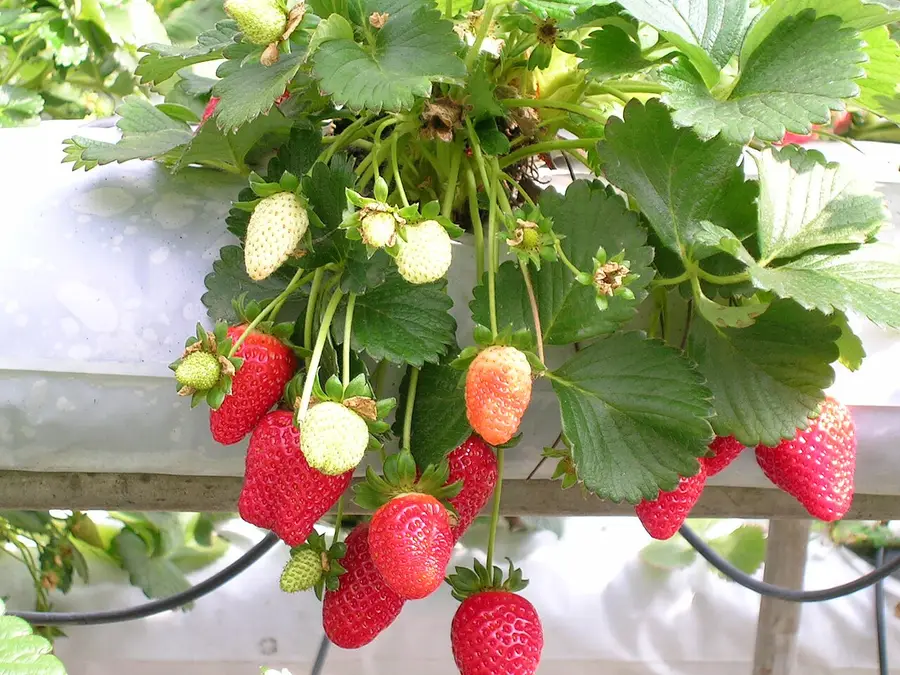
The red, fleshy part is the swollen flower base. The tiny "seeds" on its surface are the true fruits (achenes), each holding a single seed.
Classification
- KingdomPlantae
- PhylumTracheophyta
- ClassMagnoliopsida
- OrderRosales
- FamilyRosaceae
- GenusFragaria
- SpeciesFragaria × ananassa
Native range
It has no wild range. It arose in France in the mid-18th century from a cross between the North American Fragaria virginiana and Fragaria chiloensis brought from Chile.
Growing conditions
Light
Full sun.
Water
Regular; keep the soil moist.
Soil
Humus-rich, free-draining, slightly acid soil.
Temperature
Cold hardy; the flowers are damaged by late frosts.
Replace plants every 3–4 years with young plants grown from the runners.
Toxicity
ASPCA lists the strawberry genus (Fragaria) as non-toxic to cats, dogs and horses.
In an emergency call your local poison centre; for pets, contact a vet straight away. See also: plants and pets.
Look-alikes
- Wild strawberry (Fragaria vesca): Grows naturally in Türkiye's forests; its fruits are small and very fragrant.
- Mock strawberry (Potentilla indica): Its flowers are yellow and its fruit is tasteless.
Questions
Is a strawberry really a fruit?
Botanically, the red fleshy part is the swollen flower base. The true fruits are the tiny seed-like achenes on its surface.
Are strawberries safe for cats and dogs?
ASPCA lists the strawberry genus as non-toxic to cats, dogs and horses.
Garden strawberry: when does it flower?
In spring: April–May. Months are for temperate northern-hemisphere climates and shift with altitude and weather.
Garden strawberry: how do you grow it?
Light: Full sun. Water: Regular; keep the soil moist. Soil: Humus-rich, free-draining, slightly acid soil. Temperature: Cold hardy; the flowers are damaged by late frosts. Replace plants every 3–4 years with young plants grown from the runners.
Garden strawberry: is it toxic to cats and dogs?
Non-toxic to cats and dogs. Non-toxic to pets (ASPCA).
Garden strawberry: what is its scientific name?
Fragaria × ananassa (Duchesne ex Weston) Duchesne ex Rozier, in the genus Fragaria and the family Rosaceae.
Sources
- Wikipedia: Strawberry
- ASPCA Animal Poison Control: Strawberry (Fragaria)
- World Flora Online
- Plants of the World Online (Kew) · native range (WCVP)
- GBIF · classification
- Wikidata
Checked: 2026-11-17. Spotted a mistake? Tell us.