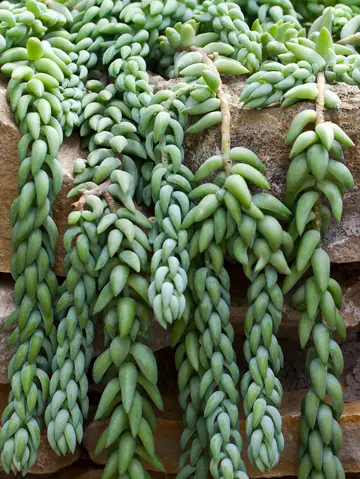
Description
Form
succulent shrub, perennial, evergreen
Height: 0.3–1 m in a pot; 2–5 m in the wild
Flower colour
Pink
Flowering
No reliable data in the sources.
Habitat
Leaves
Opposite, small (1–2 cm), round, fleshy, bright green leaves on reddish-brown branches.
Flowers
Small, star-shaped pink flowers that open at the end of the dry season in the wild; it rarely flowers in a pot.
Fruit and seeds
Small, pinkish, winged fruits.
Classification
- KingdomPlantae
- PhylumTracheophyta
- ClassMagnoliopsida
- OrderCaryophyllales
- FamilyDidiereaceae
- GenusPortulacaria
- SpeciesPortulacaria afra
Native range
According to POWO it is native to the Cape provinces, KwaZulu-Natal and the northern provinces of South Africa, and to Eswatini, Mozambique and Kenya.
IUCN Red List status: Least concern (LC).
Care
Light
Bright light with a few hours of direct sun.
Water
When the soil is completely dry; very little in winter.
Soil
Cactus and succulent compost, or a very free-draining mix with added grit or perlite.
Temperature
Not frost hardy.
Roots easily from cuttings; it takes pruning well and can be shaped as a bonsai.
Culture and history
Food for elephants
In South Africa this shrub, called spekboom, is an important food for elephants, kudus and tortoises, and it is planted to restore degraded thicket.
Look-alikes
- Jade plant: Very similar in a pot, but its leaves are larger (3–9 cm), thick and flat, and its trunk thicker and grey. ASPCA lists the jade plant as toxic to cats and dogs. Compare side by side →
Questions
How do I tell elephant bush from a jade plant?
Elephant bush has small (1–2 cm), round leaves on thin, reddish branches. The jade plant (Crassula ovata) has larger, thicker leaves and a thicker trunk.
Elephant bush: how do you care for it?
Light: Bright light with a few hours of direct sun. Water: When the soil is completely dry; very little in winter. Soil: Cactus and succulent compost, or a very free-draining mix with added grit or perlite. Temperature: Not frost hardy.
Elephant bush: how do you propagate it?
Roots easily from cuttings; it takes pruning well and can be shaped as a bonsai.
Elephant bush: what is its scientific name?
Portulacaria afra Jacq., in the genus Portulacaria and the family Didiereaceae.
Sources
- Wikipedia: Portulacaria afra
- World Flora Online
- Plants of the World Online (Kew) · native range (WCVP)
- GBIF · classification
- Wikidata
Checked: 2026-11-16. Spotted a mistake? Tell us.