Description
Form
tree, perennial, deciduous
Height: 15–30 m
Flower colour
PurpleBrown
Flowering
February–March
Habitat
Leaves
Round or inverted egg-shaped leaves, often blunt or slightly notched at the tip; sticky when young ("glutinosa" means sticky).
Flowers
In late winter, before the leaves, hanging purple-brown male catkins and small reddish female cones.
Fruit and seeds
Small (1–2 cm), woody, cone-like fruit clusters; the seeds float and are carried by water.
Classification
- KingdomPlantae
- PhylumTracheophyta
- ClassMagnoliopsida
- OrderFagales
- FamilyBetulaceae
- GenusAlnus
- SpeciesAlnus glutinosa
Native range
According to POWO it is native to most of Europe, North Africa (Morocco, Algeria, Tunisia), Türkiye, the Caucasus, Iran and western Siberia east to Kazakhstan.
IUCN Red List status: Least concern (LC).
Culture and history
A nitrogen-fixing tree
Alder roots carry nodules where they live with bacteria called Frankia, which turn nitrogen from the air into a form the plant can use; this lets alder grow on poor, wet soils and enrich them.
Wood that blushes
Freshly cut alder wood turns a reddish-orange colour on contact with the air.
Look-alikes
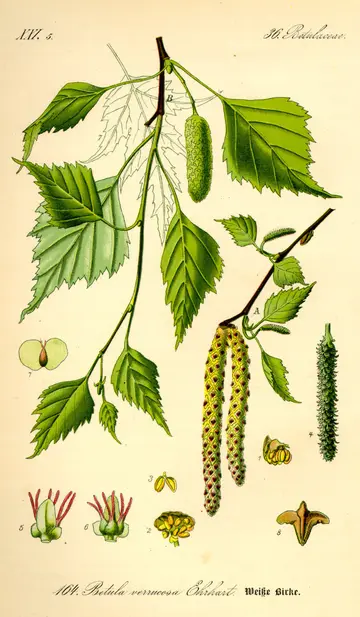
- Silver birch: Same family, with similar catkins, but its trunk is white and its leaves triangular and pointed. Compare side by side →
Questions
Where does black alder grow?
Along streams, lake shores, in marshes and in frequently flooded lowland forests; its roots can tolerate standing in water.
How do you tell black alder from birch?
Both belong to the birch family and have similar catkins. Birch has a white trunk and triangular, pointed leaves; black alder has round or inverted egg-shaped leaves that are often blunt or slightly notched at the tip.
How does black alder enrich the soil?
Its roots carry nodules where it lives with bacteria called Frankia. These bacteria turn nitrogen from the air into a form the plant can use, so alder can grow on poor, wet soils and enrich them.
Black alder: when does it flower?
In winter and spring: February–March. Months are for temperate northern-hemisphere climates and shift with altitude and weather.
Black alder: what is its scientific name?
Alnus glutinosa (L.) Gaertn., in the genus Alnus and the family Betulaceae.
Sources
- Wikipedia: Alnus glutinosa
- World Flora Online
- Plants of the World Online (Kew) · native range (WCVP)
- GBIF · classification
- Wikidata
Checked: 2026-11-17. Spotted a mistake? Tell us.