Description
Form
herbaceous, perennial, evergreen
Height: 2–7 m
Flower colour
PurpleYellow
Flowering
No reliable data in the sources.
Habitat
Leaves
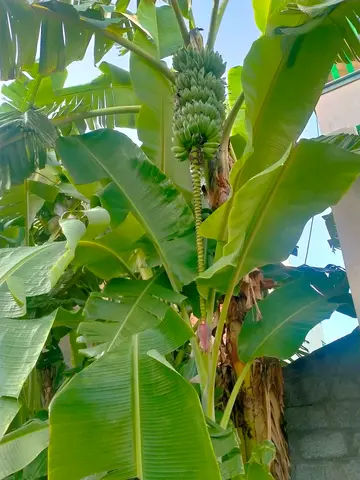
Very large (2–3 m), paddle-shaped leaves that tear easily along the veins in the wind. The leaf sheaths wrap around each other to form a false stem.
Flowers
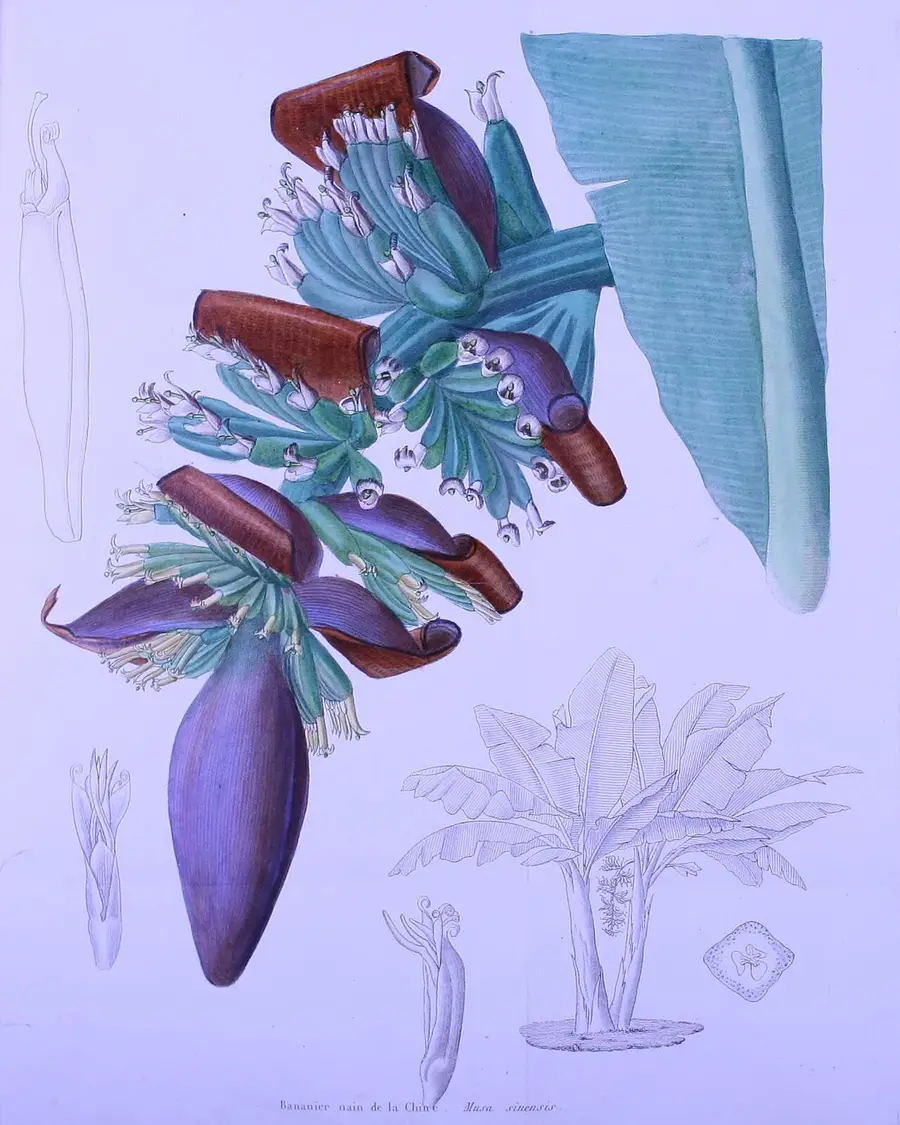
A drooping flower spike emerges from the centre of the false stem; the flowers sit in rows under thick, purple-red bracts. Female flowers (which become bananas) open first, male flowers at the tip.
Fruit and seeds
Botanically a banana is a berry. Wild bananas are full of hard seeds; cultivated bananas are seedless and are propagated from suckers.
Classification
- KingdomPlantae
- PhylumTracheophyta
- ClassLiliopsida
- OrderZingiberales
- FamilyMusaceae
- GenusMusa
- SpeciesMusa acuminata
Native range
According to POWO it is native from India, Sri Lanka and Bangladesh to Myanmar, Thailand, Vietnam and southern China, and on to Malaysia, Indonesia and the Philippines. It is grown throughout the tropics.
IUCN Red List status: Least concern (LC).
Growing conditions
Light
Full sun.
Water
Plentiful.
Soil
Deep, fertile, free-draining soil.
Temperature
Likes heat; growth stops below 10 °C and frost kills the leaves.
Culture and history
A world of one variety
Most bananas in world trade belong to a single group of cultivars (Cavendish). Because all the plants are genetically the same, one disease can threaten the whole crop: in the mid-20th century the previous leading variety, Gros Michel, was wiped out commercially by a fungal disease.
Toxicity
ASPCA lists the banana (Musa acuminata) as non-toxic to cats, dogs and horses.
In an emergency call your local poison centre; for pets, contact a vet straight away. See also: plants and pets.
Questions
Is a banana plant a tree?
No. It is a giant herbaceous plant; its "trunk" is not woody but made of tightly wrapped leaf sheaths.
Why does a banana plant die after fruiting?
Each false stem flowers and fruits only once and then dies; it is replaced by suckers from the base.
Banana: how do you grow it?
Light: Full sun. Water: Plentiful. Soil: Deep, fertile, free-draining soil. Temperature: Likes heat; growth stops below 10 °C and frost kills the leaves.
Banana: is it toxic to cats and dogs?
Non-toxic to cats and dogs. Non-toxic to pets (ASPCA).
Banana: what is its scientific name?
Musa acuminata Colla, in the genus Musa and the family Musaceae.
Sources
- Wikipedia: Musa acuminata
- ASPCA Animal Poison Control: Banana (Musa acuminata)
- World Flora Online
- Plants of the World Online (Kew) · native range (WCVP)
- GBIF · classification
- Wikidata
Checked: 2026-11-17. Spotted a mistake? Tell us.