Description
Form
climber, perennial, evergreen
Height: Trails or climbs 1–3 m indoors
Flowering
No reliable data in the sources.
Habitat
Leaves
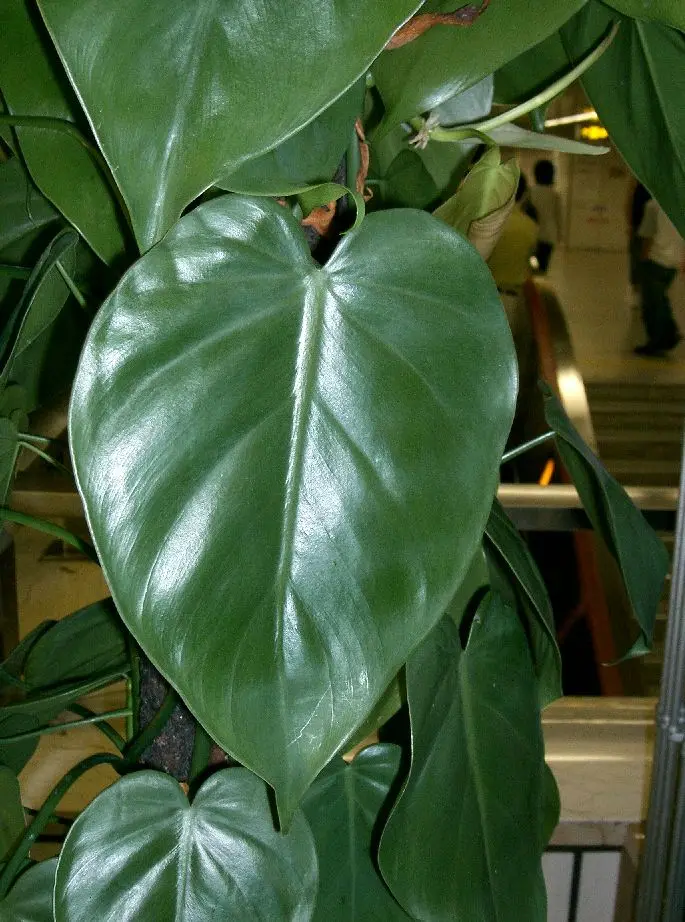
Thin, glossy, heart-shaped leaves; new leaves unfold from a brownish sheath. Cultivars such as 'Brasil' have yellow stripes.
Flowers
Almost never flowers indoors.
Classification
- KingdomPlantae
- PhylumTracheophyta
- ClassLiliopsida
- OrderAlismatales
- FamilyAraceae
- GenusPhilodendron
- SpeciesPhilodendron hederaceum
Native range
According to POWO it is native over a wide area from Mexico and Central America through the Caribbean to Bolivia and southern Brazil.
Care
Light
Low to bright indirect light.
Water
When the top 2–3 cm of soil are dry; no water in the saucer.
Soil
Free-draining, humus-rich mix.
Temperature
16–29 °C.
Stem cuttings root easily in water.
Toxicity
ASPCA lists it as toxic to cats, dogs and horses. It contains insoluble calcium oxalate crystals; chewing causes pain and burning of the mouth, tongue and lips, drooling, vomiting and difficulty swallowing; cats and dogs may vomit.
In an emergency call your local poison centre; for pets, contact a vet straight away. See also: plants and pets.
Look-alikes
- Golden pothos: Very similar, but its leaves are thicker, more leathery and usually marbled with yellow; philodendron leaves are softer and grow from a sheath. Compare side by side →
Questions
How do I tell a philodendron from a pothos?
Philodendron leaves are thinner and softer, more heart-shaped, and each new leaf emerges from a papery sheath; pothos leaves are thicker, with a groove along the stalk.
Heartleaf philodendron: how do you care for it?
Light: Low to bright indirect light. Water: When the top 2–3 cm of soil are dry; no water in the saucer. Soil: Free-draining, humus-rich mix. Temperature: 16–29 °C.
Heartleaf philodendron: how do you propagate it?
Stem cuttings root easily in water.
Heartleaf philodendron: is it toxic to cats and dogs?
Toxic to cats and dogs; Mildly toxic / irritant to people. Calcium oxalate; mouth irritation.
Heartleaf philodendron: what is its scientific name?
Philodendron hederaceum (Jacq.) Schott, in the genus Philodendron and the family Araceae.
Sources
- Wikipedia: Philodendron hederaceum
- World Flora Online
- Plants of the World Online (Kew) · native range (WCVP)
- GBIF · classification
- Wikidata
- ASPCA Animal Poison Control: Heartleaf Philodendron (Philodendron hederaceum)
Checked: 2026-11-16. Spotted a mistake? Tell us.