Description
Form
herbaceous, perennial
Height: Up to 15 cm
Flower colour
PurpleWhite
Flowering
February–April
Habitat
Leaves
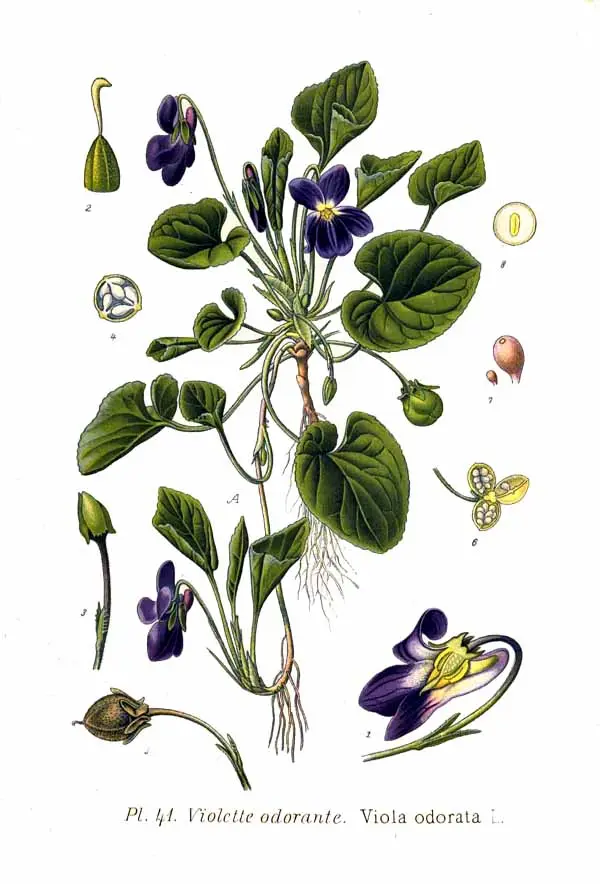
Long-stalked, kidney- or heart-shaped leaves up to 6 cm with blunt teeth and downward-pointing hairs on the stalks, all from a ground-level rosette. The plant spreads by runners (stolons).
Flowers
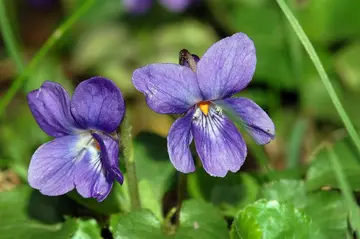
Single flowers on long stalks, with five petals, the lowest forming a short spur at the back. Usually deep purple, sometimes white; very fragrant.
Fruit and seeds
A round capsule; ants carry away the seeds.
Classification
- KingdomPlantae
- PhylumTracheophyta
- ClassMagnoliopsida
- OrderMalpighiales
- FamilyViolaceae
- GenusViola
- SpeciesViola odorata
Native range
According to POWO it is native to Europe south of Scandinavia, northwest Africa (Morocco, Algeria, Tunisia), Macaronesia, Türkiye, the Caucasus, western Asia and Kazakhstan. It has been introduced to the Americas, Scandinavia, South and East Asia, Australia and New Zealand.
Growing conditions
Light
Partial shade.
Water
Moderate; likes moist soil.
Soil
Humus-rich, moist soil.
Temperature
Hardy.
Culture and history
The vanishing scent
Ionones, the compounds behind the violet scent, briefly "switch off" the smell receptors in the nose, so after a few sniffs the scent seems to vanish and returns a few minutes later.
Perfume and sweets
Violet scent is widely used in perfumery, today mostly from synthetic ionones. In Europe the flowers are candied in sugar to decorate desserts.
Look-alikes
- Garden pansy (Viola × wittrockiana): Large-flowered, many-coloured hybrid violets grown in gardens, with almost no scent. Compare side by side →
- African violet: Similar name, but a hairy-leaved houseplant from a completely different family. Compare side by side →
Questions
Why does the scent of violets disappear?
Ionones in the scent briefly tire the smell receptors in the nose; after a few minutes the scent can be smelled again.
Sweet violet: when does it flower?
In winter and spring: February–April. Months are for temperate northern-hemisphere climates and shift with altitude and weather.
Sweet violet: how do you grow it?
Light: Partial shade. Water: Moderate; likes moist soil. Soil: Humus-rich, moist soil. Temperature: Hardy.
Sweet violet: what is its scientific name?
Viola odorata L., in the genus Viola and the family Violaceae.
Sources
- Wikipedia: Viola odorata
- World Flora Online
- Plants of the World Online (Kew) · native range (WCVP)
- GBIF · classification
- Wikidata
Checked: 2026-11-16. Spotted a mistake? Tell us.