Description
Form
tree, perennial, deciduous
Height: 20–35 m
Flower colour
Green
Flowering
March–April
Habitat
Leaves
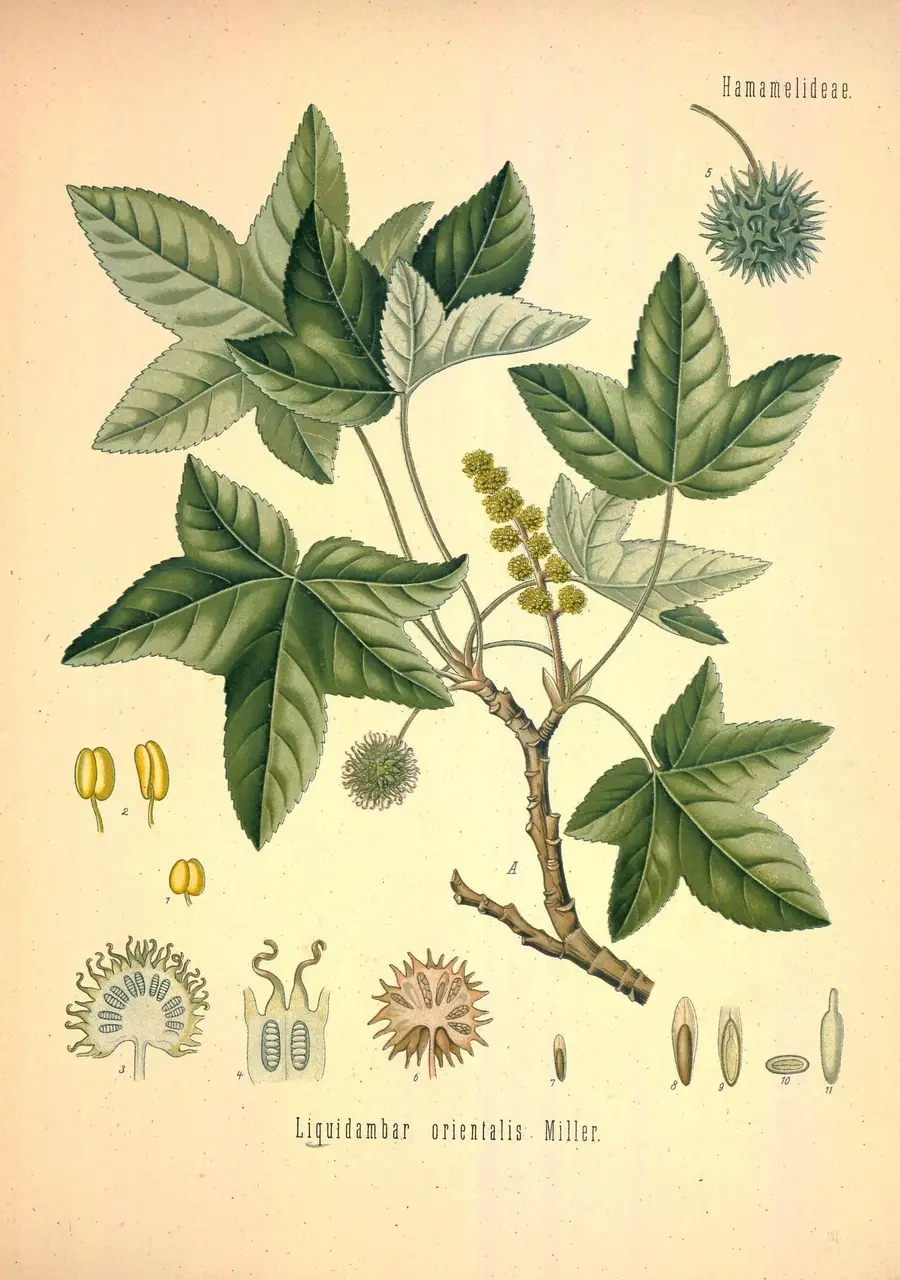
Long-stalked, alternate, hand-shaped leaves with five toothed lobes, like a smaller, more deeply cut plane leaf; yellow and red in autumn.
Flowers
Separate male and female flowers on the same tree: male flowers in short spikes, female flowers in round heads that turn from green to reddish.
Fruit and seeds
Spiky, ball-shaped clusters of capsules.
Classification
- KingdomPlantae
- PhylumTracheophyta
- ClassMagnoliopsida
- OrderSaxifragales
- FamilyAltingiaceae
- GenusLiquidambar
- SpeciesLiquidambar orientalis
Native range
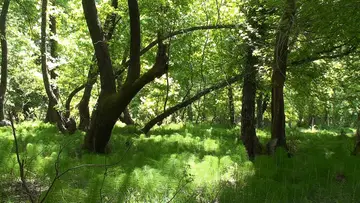
According to POWO its native range is limited to Türkiye and the East Aegean Islands; the only population outside Türkiye is in a narrow valley on the north coast of Rhodes. It is a Tertiary relict: its closest relatives now live in East Asia and North America.
IUCN Red List status: Endangered (EN).
Culture and history
Storax
The aromatic balsam obtained by wounding the bark (sığla yağı, storax) has been traded since antiquity and is still collected by hand in the Köyceğiz area.
Look-alikes
- Oriental plane: Has similar lobed leaves, but they are much larger; its bark peels off in patches and its fruit balls hang in strings on long stalks. Compare side by side →
Questions
Is the oriental sweetgum endangered?
Yes. The IUCN lists it as Endangered; its wetland forests in southwestern Türkiye have shrunk greatly.
Oriental sweetgum: when does it flower?
In spring: March–April. Months are for temperate northern-hemisphere climates and shift with altitude and weather.
Oriental sweetgum: what is its scientific name?
Liquidambar orientalis Mill., in the genus Liquidambar and the family Altingiaceae.
Sources
- Wikipedia: Liquidambar orientalis
- World Flora Online
- Plants of the World Online (Kew) · native range (WCVP)
- GBIF · classification
- Wikidata
Checked: 2026-11-16. Spotted a mistake? Tell us.