Description
Form
succulent, perennial, evergreen
Height: 3–6 cm (grafted ball)
Flower colour
PinkWhite
Flowering
No reliable data in the sources.
Habitat
Leaves
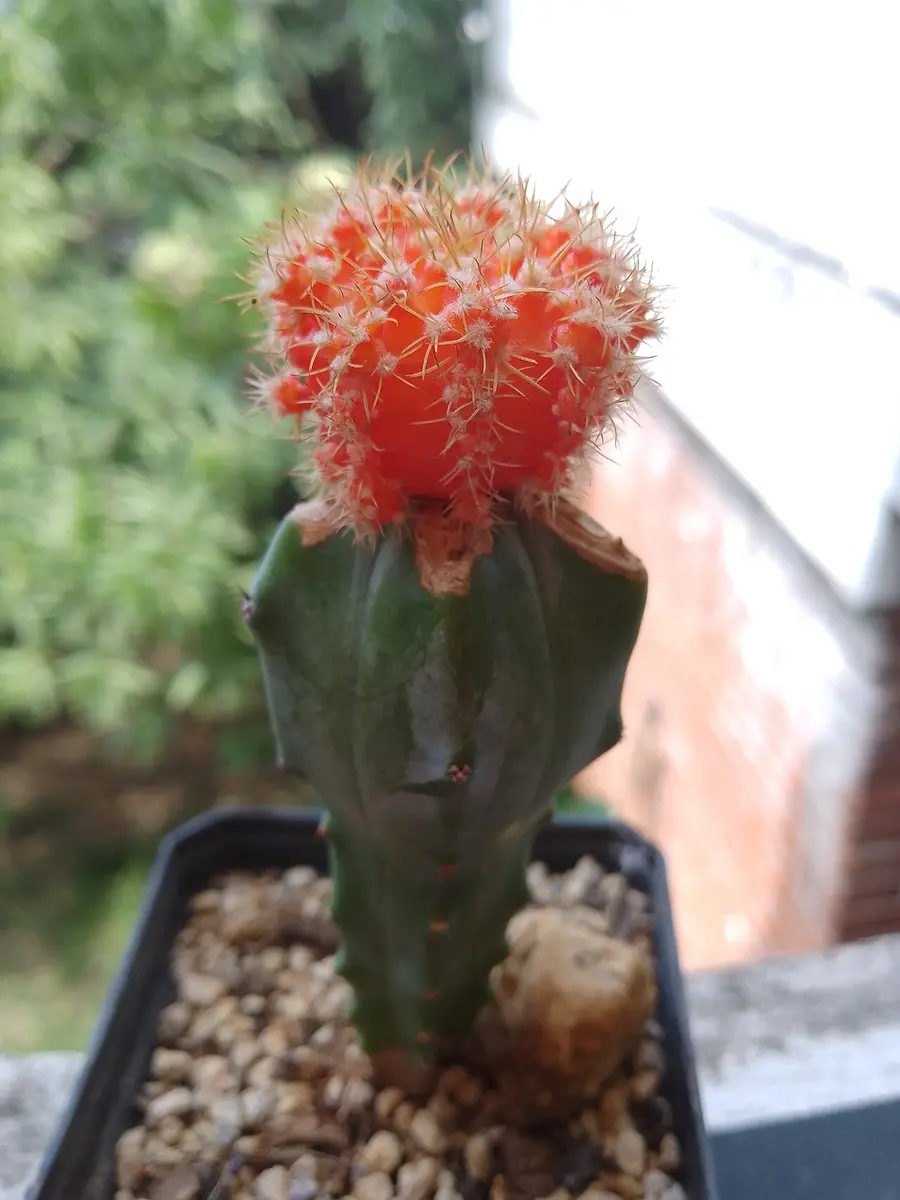
No leaves. The globe-shaped stem has about 8 ribs carrying small, curved spines.
Flowers
Pink, white or greenish funnel-shaped flowers near the top.
Classification
- KingdomPlantae
- PhylumTracheophyta
- ClassMagnoliopsida
- OrderCaryophyllales
- FamilyCactaceae
- GenusGymnocalycium
- SpeciesGymnocalycium mihanovichii
Native range
According to POWO it is native to Paraguay and north-eastern Argentina. Wild plants are grey-green, brownish or reddish.
IUCN Red List status: Least concern (LC).
Care
Light
Bright indirect light; coloured forms scorch in strong midday sun.
Water
Little. Water when the soil is completely dry; in winter once a month or not at all.
Soil
Cactus and succulent compost, or a very free-draining mix with added grit or perlite.
Temperature
10–27 °C.
Grafted plants have a limited life: the coloured ball or the green rootstock may rot after a few years. The rootstock is usually a fast-growing dragon fruit cactus (Selenicereus).
Culture and history
Why grafted?
The red, orange and yellow "moon cacti" are mutant forms that cannot produce chlorophyll. Unable to photosynthesise, they cannot live on their own roots; the green rootstock feeds them.
Questions
Why isn't the moon cactus ball green?
These forms have no chlorophyll. The plant cannot photosynthesise and takes its food from the green cactus it is grafted onto.
Moon cactus: how do you care for it?
Light: Bright indirect light; coloured forms scorch in strong midday sun. Water: Little. Water when the soil is completely dry; in winter once a month or not at all. Soil: Cactus and succulent compost, or a very free-draining mix with added grit or perlite. Temperature: 10–27 °C. Grafted plants have a limited life: the coloured ball or the green rootstock may rot after a few years. The rootstock is usually a fast-growing dragon fruit cactus (Selenicereus).
Moon cactus: what is its scientific name?
Gymnocalycium mihanovichii (Frič & Gürke) Britton & Rose, in the genus Gymnocalycium and the family Cactaceae.
Sources
- Wikipedia: Gymnocalycium mihanovichii
- World Flora Online
- Plants of the World Online (Kew) · native range (WCVP)
- GBIF · classification
- Wikidata
Checked: 2026-11-16. Spotted a mistake? Tell us.