Description
Form
succulent, perennial, evergreen
Height: 2–4 cm
Flower colour
Yellow
Flowering
September–November
Habitat
Leaves
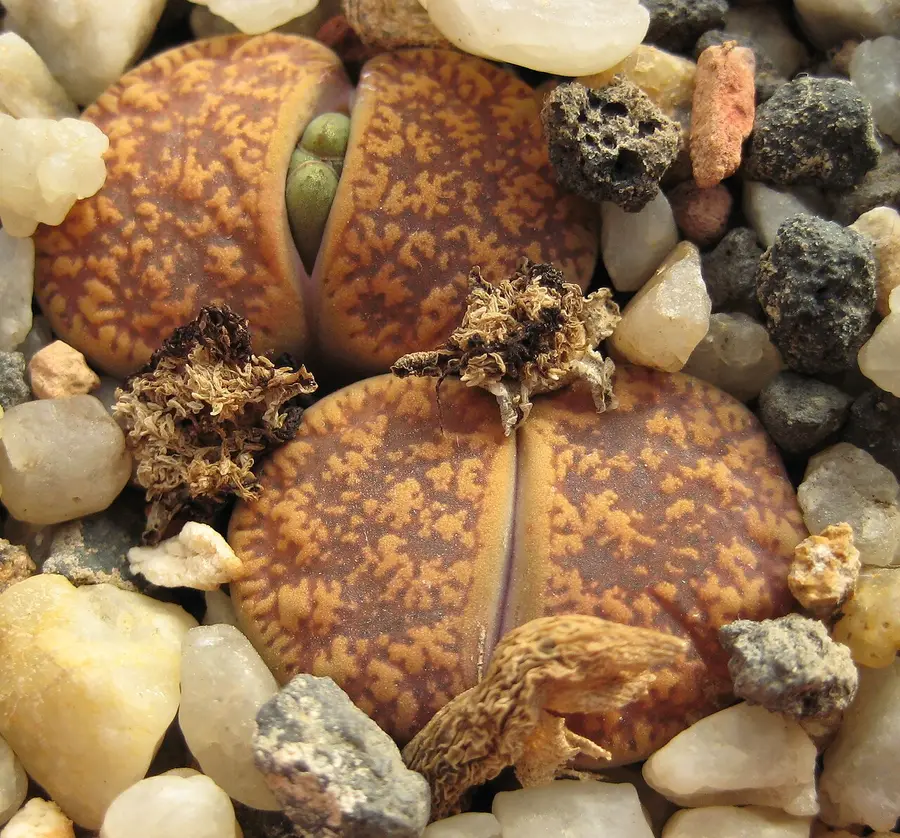
Two thick, fused leaves form a "stone". Their flat tops have translucent "windows" that let light inside, and patterns that mimic the surrounding stones.
Flowers
A single yellow, daisy-like flower emerges from the slit between the two leaves.
Fruit and seeds
A capsule that opens when wetted by rain and scatters its seeds.
Classification
- KingdomPlantae
- PhylumTracheophyta
- ClassMagnoliopsida
- OrderCaryophyllales
- FamilyAizoaceae
- GenusLithops
- SpeciesLithops lesliei
Native range
According to POWO it is native to the Cape, Free State and northern provinces of South Africa and to Botswana, growing among stones in dry grassland.
Care
Light
Very bright light; a sunny windowsill.
Water
Very little, and by season: none during the summer rest or while the old leaves are drying (winter to spring); water sparingly in autumn, the growing and flowering season.
Soil
An almost entirely mineral, very free-draining mix.
Temperature
10–30 °C.
Each year a new pair of leaves emerges between the old pair, which shrivels as it passes its water to the new one. Watering at this stage rots the plant.
Culture and history
Camouflage
The colours and patterns of living stones resemble the stones where they grow; this is explained as camouflage that helps protect them from grazing animals.
Look-alikes
- Other Lithops species: There are about 30 Lithops species in hundreds of colour and pattern forms; plants are often sold without a species name.
Questions
Why do living stones die?
Usually from overwatering. They want no water at all during the summer rest or while they are changing leaves.
Are living stones a cactus?
No. Living stones belong to the ice plant family (Aizoaceae); cacti are a separate family (Cactaceae). Both store water in their tissues, but they are not closely related.
Living stones: when does it flower?
In autumn: September–November. Months are for temperate northern-hemisphere climates and shift with altitude and weather.
Living stones: how do you care for it?
Light: Very bright light; a sunny windowsill. Water: Very little, and by season: none during the summer rest or while the old leaves are drying (winter to spring); water sparingly in autumn, the growing and flowering season. Soil: An almost entirely mineral, very free-draining mix. Temperature: 10–30 °C. Each year a new pair of leaves emerges between the old pair, which shrivels as it passes its water to the new one. Watering at this stage rots the plant.
Living stones: what is its scientific name?
Lithops lesliei (N.E.Br.) N.E.Br., in the genus Lithops and the family Aizoaceae.
Sources
- Wikipedia: Lithops
- World Flora Online
- Plants of the World Online (Kew) · native range (WCVP)
- GBIF · classification
- Wikidata
- Wikipedia
Checked: 2026-11-16. Spotted a mistake? Tell us.